



A power of attorney (POA) is one of the most important documents to include in your estate plan. Thankfully, the California Probate Code provides clear guidelines for creating one.
What is a durable power of attorney in California?
A durable power of attorney is a legal document that lets you name someone to make financial or other specified decisions on your behalf. Depending on the powers granted, the agent's authority can continue if you become incapacitated. When you create a California power of attorney, you’ll frequently see these terms:
- Principal. The person creating the power of attorney (you)
- Attorney-in-fact (also called an agent). The person or people you give the legal authority to act on your behalf
First, you should determine the specific attorney-in-fact powers you wish to grant, as California has different types of power of attorney, which can be both durable and nondurable, depending on particular circumstances and needs.
What are the main types and features of power of attorney in California?
A power of attorney can vary based on the scope of authority it gives an agent and when that authority takes effect. Here’s an overview of the primary types of power of attorney you can establish in California.
- General power of attorney: Gives an agent broad authority over specified financial or legal matters
- Limited power of attorney: Gives an agent authority only for certain matters or transactions
- Durable power of attorney: Remains effective if the principal later becomes incapacitated, provided the document contains the required durability language
- Springing power of attorney: Becomes effective only at a specified future time or when a stated event occurs, such as incapacity; a springing POA may be either durable or nondurable
For estate planning purposes, durability matters because it allows the agent's authority to continue if the principal later becomes incapacitated. A properly drafted durable POA may reduce the need for family members to seek a court-appointed conservator to manage your affairs if you become unable to make your own decisions.
Durability has no effect on scope—financial durable POA does not generally authorize health care decisions, nor can a health care POA authorize financial transactions.
What is the difference between a durable power of attorney and a medical power of attorney in California?
A durable power of attorney generally gives an agent authority to manage financial or other specified matters on your behalf, including after you become incapacitated. A medical power of attorney, commonly addressed through an advance health care directive in California, lets you name someone to make health care decisions for you if you cannot make them yourself.
These documents serve different purposes. If you want someone to handle both your financial affairs and health care decisions, you generally need to address each area through the appropriate document.
What are the requirements for a durable power of attorney in California?
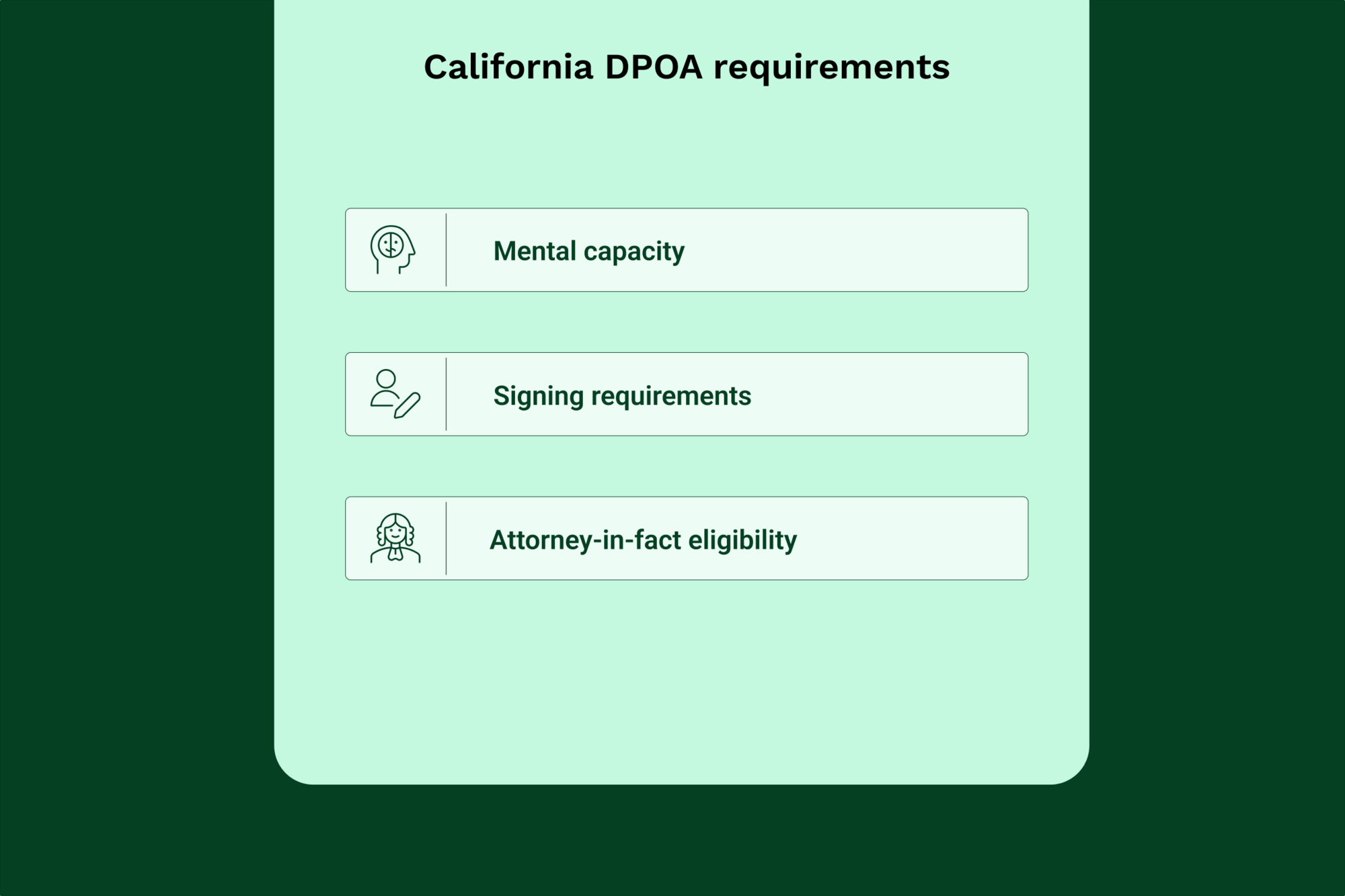
You must satisfy specific California durable power of attorney requirements outlined in the California Probate Code.
Mental capacity
As the principal, you must have the capacity to contract when creating any power of attorney, so create your durable power of attorney while you have sufficient legal capacity to understand the authority you are granting and the document’s effect.
Signing requirements
According to CA Prob. Code §. 4121, your durable POA must meet the following signing requirements to be legally valid:
- Includes the date of execution
- Signed by you (the principal) or by another adult acting under your direction and in your presence
- Notarized OR signed by two qualified witnesses
If you choose to have your durable power of attorney witnessed, the witnesses must be adults and watch you sign the document (or acknowledge your signature). Your attorney-in-fact cannot serve as a witness. If the POA may affect real property, California law recommends acknowledgment before a notary public so the document can be recorded more easily.
Durability language
To make a power of attorney durable, the document must include language showing that the agent’s authority will continue despite your later incapacity or that the POA will become effective upon your incapacity.
Attorney-in-fact eligibility
Your attorney-in-fact must be an adult with the capacity to contract in order to serve in this role. In addition, they must meet the requirements outlined in CA Prob. Code §§. 4200 to 4207. Here are the takeaways:
- You can (but aren’t required to) name multiple attorneys-in-fact
- If you name more than one, they must act unanimously
- You can designate successor attorneys-in-fact to step in if your primary becomes unavailable
Beyond the legal eligibility requirements, choose someone you trust who understands your wishes and has the time and ability to manage your affairs responsibly. Your agent should also have the time and ability to carry out their responsibilities, so try to pick someone who’s trustworthy and financially responsible.

How to create a durable power of attorney in California
Now that you’re familiar with the requirements for a durable POA in California, follow the steps below to create one for your estate plan.
Step 1: Determine the powers to grant
Your durable POA should clearly specify which financial and legal decisions you want your agent to handle. For instance, you can specify if you want your agent to handle some or all of the following matters:
- Managing bank accounts, investments, and financial transactions
- Paying bills and handling tax matters
- Operating your business affairs
- Managing retirement accounts and insurance policies
You may need to create a separate advance healthcare directive to designate someone to make medical choices on your behalf if you are unable to do so.
Step 2: Select a trusted agent
Building on the eligibility requirements discussed earlier, take time to consider who would best serve as your attorney-in-fact. Choose someone you trust who understands your wishes and has the time and ability to manage your affairs responsibly. Before naming them, discuss the responsibilities involved and confirm that they're willing to serve. You can also name co-agents or designate successor agents who can step in if your primary agent can no longer serve.
Step 3: Draft the document
You can create your durable POA using California’s Uniform Statutory Form Power of Attorney, which can be downloaded here, as a starting point.
While this can be useful, you may want to consult an attorney or use a reputable POA service if you need to personalize the document. LegalZoom offers power of attorney plans with attorney support available for personalized guidance.
If you decide to use a pre-drafted template, you may want to at least have an attorney review your final document. If you decide to forego legal advice, read the mandatory warning statement found in CA Prob. Code §. 4128, and provide it to your agent.
Step 4: Include necessary language
For the document to remain in effect after you become incapacitated, you must include specific language. According to CA Prob. Code §. 4124, you can establish this with the following statements:
- “This power of attorney shall not be affected by subsequent incapacity of the principal.”
- “This power of attorney shall become effective upon the incapacity of the principal.”
Be specific about when you want the powers to take effect. It can become effective immediately or upon a specified future event, such as your incapacity.
Step 5: Sign and finalize the document
Once you create the document, sign the durable POA in front of a California notary public or two witnesses. Keep the original in a secure, accessible location and give your agent a copy.
If the POA will be used for real estate matters, you may also need to record it with the appropriate county recorder's office. You can provide copies to banks or other financial institutions that may need to recognize your agent's authority.
When does a durable power of attorney take effect in California?
A durable POA can take effect immediately after it is properly executed or at a later time specified in the document. A springing power of attorney, for example, becomes effective only when a specified future event occurs, such as the principal's incapacity.
Does a durable power of attorney need to be notarized in California?
In California, a durable power of attorney generally must be either acknowledged before a notary public or signed by at least two qualifying witnesses. The witnesses must be adults, cannot be the attorney-in-fact, and must witness the principal signing the POA or acknowledging the signature or the POA.
- Notarization: The principal acknowledges the POA before a notary public.
- Witnesses: The principal signs the POA in the presence of at least two adult witnesses, or acknowledges the signature or POA to them. The attorney-in-fact cannot serve as a witness.
- Statutory form: If you use California's statutory form power of attorney, additional acknowledgment requirements may apply.
Following the applicable signing requirements helps ensure that the POA is legally sufficient under California law.
How to revoke a durable power of attorney in California
You can revoke a durable POA in California as long as you have the capacity to do so. You may revoke the POA in writing or follow any revocation procedure stated in the document. If you're replacing it with a new POA, clearly state that the previous POA is revoked.
You should also notify your agent and any banks or other third parties that have relied on the previous document. This can help prevent them from continuing to rely on the revoked POA.
Situations when a durable POA is used in California
A durable power of attorney may be useful when you want someone you trust to manage your financial affairs if you become unable to manage them yourself.
Here are some real-world situations in which you might use a durable POA:
- You want your daughter to manage your finances while you are recovering from an illness or injury.
- You want your brother to handle your bills and financial accounts while you are in a rehabilitation facility.
- You want to give a trusted person authority to manage certain digital assets or online accounts.
- You want your accountant to handle your banking and taxes while limiting another agent’s authority to a specific financial transaction.
- You want to choose someone in advance to manage your financial affairs if you become incapacitated.

Create a durable POA in California with LegalZoom
Creating a durable power of attorney is an essential step in safeguarding your financial and healthcare choices in the event you become incapacitated. LegalZoom’s POA service streamlines the process with user-friendly tools and reliable support to help you complete your document confidently and in compliance with California law.
Our intuitive platform walks you through each step, from naming your agent to addressing important considerations like your agent’s responsibilities and specific instructions. The process is designed to ensure your document covers all necessary details for legal validity.
If you want extra assurance, we offer the option to consult with an independent, state-licensed attorney. They can review your document and answer your questions to help ensure your durable power of attorney meets your unique needs and objectives.
"I didn't just get a POA. I got instructions, information... That was a pleasant surprise. Great service."
—Jacqueline L., power of attorney customer
FAQs about California powers of attorney
What is the difference between a non-durable power of attorney and a durable power of attorney?
A non-durable power of attorney becomes invalid if you become incapacitated, while a durable power of attorney remains effective. Specifying your POA as “durable” ensures your chosen attorney-in-fact can continue managing your affairs even if you can’t make your own decisions.
Can I have more than one agent in a durable power of attorney in CA?
Yes, you can name multiple agents in your durable power of attorney. You can limit their powers to specific areas (for instance, allowing one person to manage finances and another to manage healthcare decisions) or give two people general powers, which generally requires them to make decisions unanimously.
Is a durable power of attorney valid after death?
No, a durable power of attorney expires immediately once the principal dies. After death, the executor or administrator of the deceased’s estate typically has the authority to make decisions on their behalf.
What are the disadvantages of a durable power of attorney?
- Potential for misuse/abuse. As the agent gains broad authority, it can lead to mismanagement and fraud, especially if the principal is incapacitated.
- Lack of independent oversight. As there isn’t any judicial review, it’s hard to detect issues without third-party legal action.
- Improper documentation. If the durable power of attorney document isn’t drafted carefully, you can grant more power than intended (or not enough).
- Conflicts with agent. The right agent must be trustworthy and have financial acumen and judgment, but personal relationships often complicate the choice.
Is a durable power of attorney valid outside California?
Generally, most states have similar laws and will respect documents made elsewhere. However, some states might have slightly different rules. They might require specific witnesses or special wording for property deals, even if the durable power of attorney was correctly made according to California specifications.
The best idea is to consult a lawyer in the state you’re curious about. They can confirm any local rules or help you create a new durable power of attorney that follows both California law and the laws of the state where you'll use it.
Can a durable power of attorney be challenged in California?
In California, a durable power of attorney can indeed be challenged, typically on grounds similar to those for challenging a will or trust. Common reasons for contesting a durable power of attorney include the following arguments:
- The principal was incapacitated or not of sound mind when they created the document
- A third party improperly pressured or manipulated the principal into signing (undue influence)
- The principal or someone acting on their behalf committed forgery or fraud
Challenges can also arise if the agent appointed under the durable power of attorney breaches their fiduciary duties—for example, by misusing the principal's assets or acting against their best interests, even if the durable power of attorney itself was validly created. Interested parties, such as family members or beneficiaries, usually bring these challenges in court if they believe the durable power of attorney is invalid or being misused.
Miles Almadrones, contributed to this article.
'%20/%3e%3c/svg%3e)

'%3e%3cpath%20fill-rule='evenodd'%20clip-rule='evenodd'%20d='M9.31239%2025.5316H13.0679V14.1032H9.31239V25.5316ZM11.1913%208.46875C9.93945%208.46875%209%209.25086%209%2010.505C9%2011.5995%209.78211%2012.5389%2011.1913%2012.5389C12.6005%2012.5389%2013.3826%2011.5995%2013.3826%2010.505C13.3826%209.4082%2012.6005%208.46875%2011.1913%208.46875ZM27%2018.9577V25.5316H23.2445V19.4275C23.2445%2017.8609%2022.6174%2016.7664%2021.3679%2016.7664C20.2711%2016.7664%2019.644%2017.5463%2019.3316%2018.1756C19.1743%2018.488%2019.1743%2018.8004%2019.1743%2019.1128V25.5316H15.4165V13.9458H19.1743V15.5123C19.644%2014.7302%2020.5835%2013.6357%2022.6174%2013.6357C25.1234%2013.7908%2027%2015.3573%2027%2018.9577Z'%20fill='white'/%3e%3c/g%3e%3cdefs%3e%3cclipPath%20id='clip0_952_9489'%3e%3crect%20width='18'%20height='18'%20fill='white'%20transform='translate(9%208)'/%3e%3c/clipPath%3e%3c/defs%3e%3c/svg%3e)



