.
.





Forming a New Jersey LLC starts with filing a certificate of formation—called a "Public Records Filing" in the state's online system—with the New Jersey Division of Revenue and Enterprise Services (DORES). After approval, you'll still need to handle your EIN, NJ-REG registration, any applicable tax or employer accounts, and your internal operating agreement before you launch. This guide follows New Jersey's sequence so you can see which steps are required, which depend on your business, and what to calendar after formation.
Key takeaways
- Choose a distinguishable name and a qualifying registered agent before filing.
- Submit the certificate of formation and the $100 state fee through the DORES business formation portal.
- After approval, obtain an EIN if needed and complete NJ-REG at least 15 business days before starting business or opening another location.
- Calendar the $75 annual report deadline and check state, county, and municipal licensing before launch.
Step 1: Name your New Jersey LLC
Choose a name that meets New Jersey's designator and distinguishability rules, and confirm it before you submit the formation filing. If you plan to use a different public-facing name, check the alternate-name process at the same time. Run a name search for your preferred name and any similar variations of it before you register. LegalZoom’s free business name search tool lets you search for as many names as you want.
Free New Jersey Business Name Check
Starting a business? Use our free name check tool to see if your business name is available according to state records.
By clicking "Check Availability," I agree to LegalZoom's Terms of Use. This search is a preliminary check of state databases and does not include variations or trademarks. Results do not guarantee name availability or compliance with legal requirements.
What are the naming rules for New Jersey LLCs?
Your name needs "Limited Liability Company," "LLC," or "L.L.C." somewhere in it ("Limited" can shorten to "Ltd." and "Company" to "Co."). It also has to be distinguishable, in DORES' records, from every other registered entity and reserved name out there. Punctuation or spacing tweaks rarely make an otherwise identical name distinguishable, and DORES gets the final word on that.
Are there restricted or prohibited words?
You can't use words restricted by another statute unless you've met that statute's requirements first. Think "bank," "banking," "savings," "trust," "insurance," "engineer," "engineering," "architecture," or "architectural," terms that imply a license or status you don't actually hold. Your name also can't hint at an unlawful purpose.
How can you reserve a business name?
You can file an application for reservation of name with DORES for $50 to hold a name for 120 days. Most filers skip this and just put their chosen name directly on the certificate of formation. Run a free New Jersey business name search first, though. LegalZoom bundles a business name check into its formation services and can reserve a name for you as well.
Do you need to register an alternate name?
New Jersey requires businesses that plan to operate under a name that’s different from the one they registered under to file for an alternate name, sometimes referred to as a DBA. You register it via a registration of alternate name form for $50. It lets your LLC operate under a different name without creating a whole new entity. See our guide on filing a DBA in New Jersey.
Can you change your name later?
You can, by filing a certificate of amendment with DORES for $100. Your new name still has to be distinguishable from everyone else's. After that clears, update your name with the IRS (Form 8822-B), your bank, and any licenses or contracts tied to the old one.
Step 2: Appoint a registered agent in New Jersey
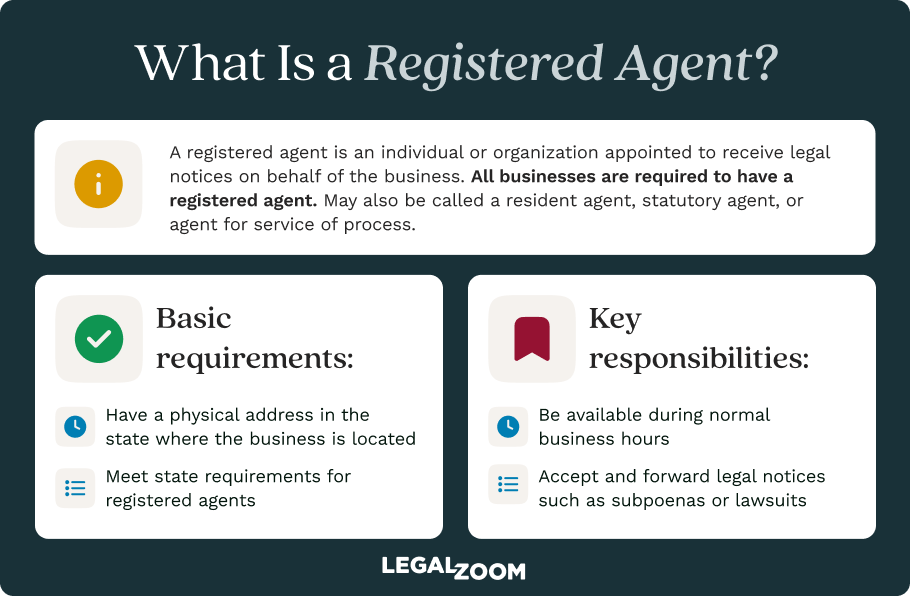
New Jersey requires every domestic LLC to list a registered agent and registered office. Choose someone or a company that can reliably receive legal papers and state correspondence at a physical New Jersey address during normal business hours; keeping that information current is an ongoing compliance responsibility.
A registered agent's job is simple: Accept service of process and official correspondence from DORES on your LLC's behalf, then get it to you.
Who can serve as a registered agent in New Jersey?
Your agent has to be either a New Jersey resident individual or a domestic or foreign entity authorized to do business in New Jersey with a business office at the registered address. A P.O. box is not enough. The agent needs a real street address and has to be there during normal business hours.
What are the privacy considerations?
The registered agent's name and address are part of the public formation record. A commercial registered agent may help keep a home address off that particular filing and receive papers during business hours, but it does not make every address or business record private, so review every formation field before submitting.
Step 3: File your New Jersey certificate of formation (Public Records Filing)
This filing creates the domestic LLC. New Jersey's formation portal labels it a Public Records Filing and routes it through DORES.
File your certificate after your name and registered agent details are settled, but before you begin operating. The standard state fee is $100. Review the application carefully, as an incorrect address, missing information, or a name conflict can delay approval and may require a corrected filing.
Filing methods compared
| Filing method | How it works | Processing guidance |
|---|---|---|
| Online | Submit and pay through the state portal using its available payment options | Check the portal estimate; processing times can vary |
| Paper filing | Use the DORES paper-filing instructions and payment method; addresses can change | Allow mail transit plus agency processing time |
| Expedited service or other accepted method | Use only the method and expedited option listed by DORES | Additional fee and timing depend on the option currently available |
| Other accepted filing method | Follow the current DORES instructions; do not rely on an old office address | See the current DORES fee schedule for available expedited services |
How do you file online?
Open the New Jersey business formation portal and select the domestic LLC option. The portal's prompts may ask for:
- Business information: Your proposed name (with designator), principal address, and business purpose
- Registered agent: Name and New Jersey street address
- Management structure: Member-managed or manager-managed, plus names and addresses
- Other provisions: Any optional extra terms, like a delayed effective date
- Signatures: The organizer's electronic signature
- Review: A summary screen before you hit submit
- Payment: $100 state filing fee, plus any selected expedited or payment charges
Use the portal's prompts and review the screen thoroughly; an automated check is not a substitute for verifying the legal name, addresses, management details, and organizer information yourself.
What information do you need to provide when filing?
- LLC name with designator
- Registered agent's name and New Jersey street address (no P.O. boxes)
- Principal business address
- Management structure
- Name and address of each member or manager
- Business purpose (a general statement covers most LLCs)
- Organizer's name and signature
Who signs the paperwork?
The organizer or organizers sign, and they don't need to be a member of the LLC. If someone else is handling the paperwork for you, make sure they actually have the authority to sign, since an unauthorized signature can hold up approval.
What is a delayed effective date?
You can specify a delayed effective date after filing, but the filing cannot be backdated. A delayed date changes when the LLC becomes effective, so confirm the downstream tax, licensing, contract, and annual-report implications before relying on it.
What do you need to know about publication and public records?
New Jersey does not impose a newspaper-publication requirement for a domestic LLC. Formation information is public through state records, so treat every address and contact field as potentially public. A commercial registered agent can address the agent and registered-office fields, but it does not guarantee privacy for every field.
Step 4: Get an EIN from the IRS
After the state approves the filing, determine whether your LLC needs a federal employer identification number (EIN) and apply directly with the IRS if so. Form the LLC with New Jersey first; the EIN application is free, and NJ-REG may request the EIN during state registration.
Apply through the IRS’ application. If you want help with the application, LegalZoom’s EIN filing service can handle the process on your behalf.
Do single-member LLCs need an EIN in New Jersey?
A single-member LLC may not need an EIN for every federal tax purpose, but one may be needed for employees, certain tax elections, banking, or New Jersey registration. Use the IRS guidance for your circumstances and do not assume that the EIN question eliminates your separate NJ-REG obligations.
Step 5: Register for New Jersey taxes (NJ-REG and business registration)
Formation approval and an EIN do not complete New Jersey business registration. Use NJ-REG to identify the state tax and employer accounts your business actually needs, and leave enough time for processing before you start operations or open another location.
Keep the federal and state identifiers separate and use the number requested by the IRS, DORES, a bank, or a contracting agency.
When do you need to file NJ-REG?
New Jersey requires businesses doing business in the state to register through NJ-REG. File after the certificate of formation is approved and, when applicable, after the EIN is issued. New Jersey generally requires registration at least 15 business days before you begin doing business or open an additional location. Confirm which tax and employer accounts apply to your business.
NJ-REG has no state filing fee. Use the NJ-REG online portal and keep the registration confirmation. Also check the portal’s business registration certificate guidance to see if it’s applicable to your LLC. A certificate may be required for public contracts, casino-related work, state grants, or other applicable programs; it is not a universal requirement for every business activity.
Are there per-partner fees for multi-member LLCs?
An LLC taxed as a partnership with more than two owners and New Jersey-source income or loss may owe a $150 fee per owner, up to $250,000, plus a 50% prepayment for the succeeding period, unless an exception applies. Review the New Jersey partnership fee guidance and NJ-1065 instructions to see if this applies to your LLC
Building a business is enough work as it is. We'll help you start your LLC with confidence.

Step 6: Create an operating agreement for your New Jersey LLC
New Jersey does not require every LLC to have a written operating agreement, but it should. This document sets the rules for how members will make decisions and share the business' economics. It is an internal governance document—not a replacement for the certificate of formation—and it does not automatically guarantee liability protection. Consider covering ownership, contributions, allocations and distributions, voting, management authority, transfers, exits, and dissolution.
Without a written agreement, the state’s LLC statute and any enforceable member agreements may fill gaps in how the company operates. Put the agreement in place before disagreements arise, and update it when ownership, management, or the business model changes.
New Jersey law sets boundaries on what an operating agreement may change, including information rights and the duty of good faith and fair dealing. Within those limits, members can tailor management, voting, profit-sharing, transfer, and exit provisions to the business.
Are there special considerations for single-member LLCs?
For a single-member LLC, an agreement can document ownership, contributions, management authority, and the intent to keep the business' records and finances separate. It is not a prerequisite to liability protection, and a separate agreement cannot replace consistent recordkeeping and compliance. A bank or counterparty may still request one.
Step 7: Obtain New Jersey business licenses and permits
New Jersey does not issue a single, catch-all business license. Requirements depend on the activity, profession, product, premises, employees, and location; state, county, and municipal approvals may all apply. Check the New Jersey licensing and certification guide and local offices before signing a lease, hiring, or opening to customers.
- State occupational/professional licenses: The Division of Consumer Affairs regulates over 100 professions, from healthcare workers and cosmetologists to real estate agents and private investigators. Electricians and plumbers go through the Board of Examiners of Electrical Contractors and the State Board of Examiners of Master Plumbers instead.
- Contractor registration: Home improvement contractors may need registration and other requirements under the Contractors' Registration Act (N.J.S.A. 56:8-136 et seq.).
- Health and food service permits: Food service businesses generally need local health approval.
- Alcohol licensing: Retail alcohol sales require the applicable municipal and state approvals under New Jersey's Alcoholic Beverage Control system.
- Cannabis licensing: Cannabis businesses need the applicable Cannabis Regulatory Commission and local approvals, plus any required state registration.
- Healthcare/childcare facilities: The Department of Health licenses home healthcare, while the Department of Children and Families handles childcare.
- Local licenses: Some municipalities require a mercantile, business, zoning, or other local approval. Check with the municipal clerk and zoning office.
- County permits: County health, planning, zoning, or other approvals may apply depending on the activity and premises.
Use the state licensing guide and the relevant county or municipality's instructions for the activity and location.
New Jersey LLC formation costs: Required vs. optional fees
Most domestic LLCs pay the $100 certificate of formation fee and the $75 annual report fee. Other costs depend on whether you reserve a name, use an alternate name, request an amendment or registered agent change, choose expedited service, hire a provider, or trigger tax, licensing, payroll, or insurance obligations.
Required New Jersey state fees
| Fee type | Cost | When it's due |
|---|---|---|
| Certificate of formation (Public Records Filing) | $100 | One-time, at filing |
| Form NJ-REG (state tax/employer registration) | No fee | Before conducting business, at least 15 business days out |
| Federal EIN | No fee | Before opening a bank account, hiring employees, or filing NJ-REG |
| Annual report | $75 | Every year, by the last day of your anniversary month |
Optional New Jersey LLC costs
| Cost | Typical amount | When you'd pay it |
|---|---|---|
| Business name reservation | $50 | If reserving a name before filing |
| Alternate name (DBA) registration | $50 | If operating under a different name |
| Certificate of amendment (name change) | $100 | If renaming after formation |
| Commercial registered agent service | Provider-dependent; $0 if self-served | Ongoing, if using a provider |
| Expedited service (where available) | Additional fees vary: $25 per filing, $50 same-day FAX, $500 two-hour, or $1,000 one-hour | Only if selected and available; check with DORES |
The risks of filing a New Jersey LLC on your own
Filing on your own can be cost-effective, but New Jersey's requirements are spread across DORES, state tax registration, and local licensing. The main risk is not the formation form alone; it is missing a separate registration, using outdated instructions, or failing to maintain the public record after approval.
- A New Jersey LLC can be formed with the wrong state fee or filing path if you rely on an old guide. Check the DORES fee schedule and business formation portal immediately before filing.
- NJ-REG is a separate registration step with its own timing. Build in the 15-business-day lead time and confirm which tax or employer accounts apply before you open or expand operations.
- A commercial registered agent service keeps your address off public record but does not solve every privacy issue. Review every address and contact field in the formation application before submission.
- Missing the $75 annual report can put the LLC's status at risk. Calendar the anniversary-month deadline and keep the registered agent information current.
- Licensing obligations depend on the activity and location, not just the LLC form. Check the state licensing guide and the relevant county or municipality before signing a lease, hiring, or opening to customers.
Start your New Jersey LLC with LegalZoom
For New Jersey LLCs, LegalZoom can help you check your business name, prepare and file your certificate of formation, and keep track of ongoing state requirements. You can also choose additional services, such as registered agent service or an operating agreement, based on what your business needs. Ready to get started? Check out LegalZoom’s New Jersey LLC formation service.
Find the right state to form an LLC
Find the right state to form an LLC
Every state has different rules, costs, and considerations for LLC formation.


New Jersey LLC FAQs
What is the New Jersey filing called?
For a domestic LLC, the formation submission is called a Public Records Filing in the state portal and results in a certificate of formation. DORES assigns an entity ID after approval; keep that separate from your EIN and any state tax account identifiers.
Does every New Jersey business need a business registration certificate?
Not every business needs a certificate for the same reason. It may be required for public contracts, casino-related work, state grants, or another applicable program. Complete NJ-REG and confirm the requirement with DORES or the contracting agency for your activity.
When is a New Jersey LLC's annual report due?
A New Jersey LLC's annual report is due by the last day of its anniversary month. Missing two consecutive reports can put the LLC's status at risk through revocation or voiding. Keep the deadline and registered agent information current and review DORES' status and reinstatement instructions if a report is missed.
What happens if a New Jersey LLC stops operating?
If you stop operating, wind up the business, settle obligations, close applicable tax and employer accounts, and file the state dissolution or termination paperwork that applies. Do not simply stop filing annual reports: two consecutive missed reports can lead to revocation or voiding, and reinstatement may require delinquent reports, fees, and registered agent information.
Keep the launch timeline tied to the NJ-REG lead time and your licensing approvals, not just formation processing. If you need a turnaround estimate or expedited service, check DORES immediately before filing.
'%20/%3e%3c/svg%3e)

'%3e%3cpath%20fill-rule='evenodd'%20clip-rule='evenodd'%20d='M9.31239%2025.5316H13.0679V14.1032H9.31239V25.5316ZM11.1913%208.46875C9.93945%208.46875%209%209.25086%209%2010.505C9%2011.5995%209.78211%2012.5389%2011.1913%2012.5389C12.6005%2012.5389%2013.3826%2011.5995%2013.3826%2010.505C13.3826%209.4082%2012.6005%208.46875%2011.1913%208.46875ZM27%2018.9577V25.5316H23.2445V19.4275C23.2445%2017.8609%2022.6174%2016.7664%2021.3679%2016.7664C20.2711%2016.7664%2019.644%2017.5463%2019.3316%2018.1756C19.1743%2018.488%2019.1743%2018.8004%2019.1743%2019.1128V25.5316H15.4165V13.9458H19.1743V15.5123C19.644%2014.7302%2020.5835%2013.6357%2022.6174%2013.6357C25.1234%2013.7908%2027%2015.3573%2027%2018.9577Z'%20fill='white'/%3e%3c/g%3e%3cdefs%3e%3cclipPath%20id='clip0_952_9489'%3e%3crect%20width='18'%20height='18'%20fill='white'%20transform='translate(9%208)'/%3e%3c/clipPath%3e%3c/defs%3e%3c/svg%3e)