.
.





To form a Michigan LLC, file articles of organization with the Department of Licensing and Regulatory Affairs (LARA), Corporations, Securities & Commercial Licensing Bureau. The standard state filing fee is $50. After formation, Michigan LLCs generally must file an annual statement by February 15 and keep a Michigan resident agent and registered office current. Below, you'll find the filing steps, costs, timelines, and ongoing compliance requirements.
Key takeaways
- Michigan LLCs are formed by filing articles of organization (CSCL/CD-700) with LARA and paying the $50 state fee.
- Your LLC name must be distinguishable and include an approved LLC designator; a name reservation and trademark search are separate, optional steps.
- Michigan requires a resident agent and registered office, and you must keep that information up to date.
- After approval, create an operating agreement and consider tax, employer, licensing, insurance, banking, and bookkeeping needs based on your business.
- Most Michigan LLCs file an annual statement by February 15 and pay the applicable fee; the first deadline may differ for LLCs formed after September 30.
Step 1: Name your Michigan LLC
Start with a name search, but treat it as one part of the process—not a guarantee that the name is available as a trademark or will be accepted without review. Choosing the name early also helps you make consistent decisions about your domain and branding.
What naming rules does Michigan require for an LLC?
The Michigan Limited Liability Company Act requires the words "limited liability company" or the abbreviation "L.L.C." or "L.C." Periods and other punctuation may be omitted. Check LARA's naming guidance before filing if your name includes regulated or restricted terms.
Your name must be distinguishable on LARA's records from existing entities covered by Michigan's naming rules, not just from other LLCs. Differences in punctuation, capitalization, or articles such as "the" may not be enough. A database search is not the same as a trademark clearance, so consider searching for similar marks before you commit to the name.
How do you check Michigan LLC name availability?
Search LARA's business entity database or use LegalZoom’s free Michigan business name search tool which lets you check as many names as you want, quickly and easily. You can search before filing to identify obvious conflicts, but LARA's records are not a substitute for a trademark search and a search result does not guarantee approval. Try reasonable variations of the name and confirm the final version includes the required LLC designator.
Can you reserve a Michigan LLC name before filing?
You can, but it’s not required. To do so, file Form CSCL/CD-540 with LARA and pay the $25 fee to reserve a name for 180 days. If you're ready to file, you can skip the reservation and submit your articles of organization instead.
Free Michigan Business Name Check
Starting a business? Use our free name check tool to check your business name against Michigan's official records.
By clicking "Check Availability," I agree to LegalZoom's Terms of Use. This search is a preliminary check of state databases and does not include variations or trademarks. Results do not guarantee name availability or compliance with legal requirements.
Step 2: Appoint a Michigan resident agent
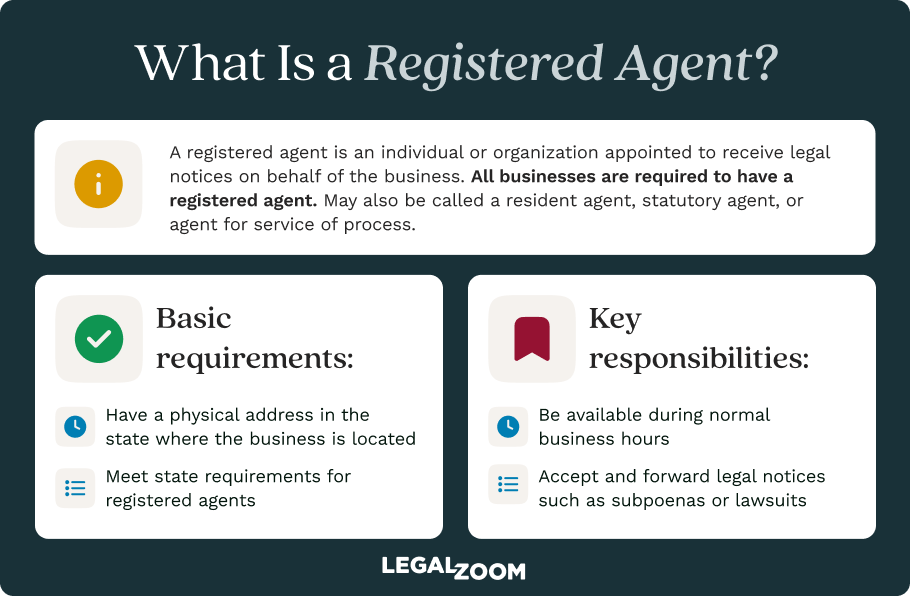
Michigan won't accept your filing without a named resident agent—the person or business designated to receive legal documents and official correspondence for the LLC. Michigan uses "resident agent" rather than "registered agent"; the role is similar, but the Michigan terminology matters on state forms. The agent's address is the registered office.
A Michigan LLC must maintain a resident agent and registered office while it exists, and LARA will not process a formation filing that omits the required information. Keep the appointment current after formation so the LLC can receive official notices and maintain an accurate public record.
Who is eligible to serve as a resident agent in Michigan?
Your resident agent needs a Michigan street address—not a P.O. box—that is available for receiving official notices as required by law. Eligible agents can include:
- You, if you meet Michigan's resident-agent requirements and have a physical street address in the state
- Another individual, like an employee, business partner, or attorney who meets the same requirements
- A domestic or foreign business entity authorized to transact business in Michigan, including a commercial resident agent service
Naming yourself costs nothing, but you have to actually be present at that address during business hours to sign for documents. A commercial service handles it for an annual fee and gives you more flexibility.
What information about your Michigan LLC's address becomes public record?
Formation filings are public records that can include the resident agent's name and address, the registered office address, and organizer information. If you use your home address, it may appear in the public state record. To avoid that, use a commercial resident-agent service, which places its business address on the record instead. If your agent or office ever changes, update LARA using the change form, CSCL/CD-520.
Step 3: File articles of organization with Michigan LARA
The articles of organization is the filing that creates your Michigan LLC. File Form CSCL/CD-700 with LARA and pay the $50 state fee, either online through the MiBusiness Registry or by an accepted paper method. The form also addresses management, purpose, duration, and the effective date, so review the current version before filing.
The form requires:
- The LLC's name, including the required designator
- A statement of purpose; a general lawful-purpose statement may be sufficient
- The resident agent's name and Michigan street address
- The registered office address
- Whether the LLC is member-managed or manager-managed
- The organizer's name and signature
Review the form instructions carefully and complete the fields that apply to your LLC. Some information is required, while other provisions—such as additional purpose or governance language—may be optional.
How do you file articles of organization for a Michigan LLC?
You can file your articles of organization in two ways.
- Online: Use the MiBusiness Registry portal and follow LARA's account and payment instructions. Online filing can make it easier to catch missing information and monitor the filing, but portal steps and payment options can change.
- By mail: Download the form and mail it with your payment to the address shown in the form or filing instructions. If you deliver documents in person or by courier, confirm LARA's office address before sending them. Mail generally adds transit time, so readers who need speed should review the expedited options.
How much does expedited processing cost for a Michigan LLC filing?
Michigan offers expedited processing for filers who need their document approved quickly. These charges are added to the standard filing fee, and submission cutoffs and service levels should be confirmed against LARA's fee schedule.
- 24-hour service: $50 surcharge (total $100)
- Same-day service: $100 surcharge (total $150); submit by 1:00 p.m.
- 2-hour service: $500 surcharge (total $550); submit by 3:00 p.m.
- 1-hour service: $1,000 surcharge (total $1,050); submit by 4:00 p.m.
Mail requests need a cover letter specifying the service level and a separate check. Online filers pick their tier during submission. These options make sense if you're trying to close a lease, sign a contract, or open a bank account that requires proof your LLC exists right now.
Step 4: Create a Michigan LLC operating agreement
Michigan does not require an operating agreement to be filed with LARA. It is still a practical governance document: It should spell out ownership, contributions, decision-making, distributions, transfers, records, and dispute procedures. Without one, Michigan's default rules may not match what the owners intended.
A written agreement can help a single-member LLC document how the business is run and can help multi-member owners agree on ownership, voting, distributions, and exit terms before disagreements arise. It supports consistent governance, but it does not by itself guarantee liability protection.
Step 5: Get an EIN and open a Michigan business bank account
After LARA approves your articles of organization, evaluate whether the LLC needs an employer identification number (EIN) based on its federal tax classification, employment, and filing responsibilities. You can apply directly through the IRS or let LegalZoom file your application on your behalf.
A single-member LLC may not need an EIN in every situation, while a multi-member LLC generally needs one for federal tax administration. Even when not strictly required, an EIN can make banking, payroll, and payment-account setup easier and keep a personal Social Security number off routine business paperwork.
What documents do Michigan banks require to open an LLC business bank account?
Most banks want the EIN confirmation letter (IRS Form CP 575 or the online confirmation) and your LARA-stamped articles of organization. Many also ask for your operating agreement, especially for multi-member LLCs, and sometimes a banking resolution authorizing a specific person to manage the account. Call ahead and confirm your bank's exact requirements.
Step 6: Register for Michigan taxes, employer accounts, licenses, and permits
Filing articles of organization creates the LLC, but it does not automatically register the business for Michigan taxes or employer accounts. The registrations you need depend on the business' activities, workers, and tax classification.
- State tax and employer registration. If your LLC engages in activity subject to Michigan sales, use, or withholding taxes, register through the Michigan Treasury process. Hiring employees may also trigger unemployment-insurance registration with the Michigan Unemployment Insurance Agency (UIA). Formation alone does not create every tax or employer account.
- Pass-through taxation. Many LLCs are taxed as pass-through entities by default, but the federal and Michigan tax result depends on the LLC's classification and the owners' facts. Do not use an old tax-year rate as evergreen copy or assume every LLC owner has the same filing obligation.
- Flow-through entity tax election. Some eligible entities may elect Michigan's flow-through entity tax, but eligibility, timing, and election-duration rules apply. The choice can affect both Michigan and federal reporting, so readers should review Treasury guidance and obtain tax advice before making the election.
- Local city income tax. Twenty-four Michigan cities impose their own income taxes under the Michigan Uniform City Income Tax Ordinance, generally 1% on residents and 0.5% on nonresidents. Detroit charges 2.4%/1.2%; Grand Rapids 1.5%/0.75%; Saginaw 1.5%/0.75%; Highland Park 2%/1%. Check with your city's income tax office if you operate in or employ people from one of these cities.
- Michigan Business Tax and Corporate Income Tax. Standard pass-through LLCs aren't subject to Michigan's Corporate Income Tax (CIT), which applies to C corporations. Elect corporate tax treatment federally, though, and you may trigger CIT obligations.
- Licenses and permits. Michigan does not have one blanket business license for every LLC. Requirements depend on the industry, activity, and location, including state occupational licensing and local permits. Start with Michigan Business One Stop, then check the relevant state licensing board and city or county office before opening.
The risks of filing a Michigan LLC yourself
Filing a Michigan LLC yourself is manageable, but Michigan-specific mistakes can cause filing delays, public-record exposure, or missed compliance obligations if you treat formation as a one-time task. Check LARA's current instructions before filing, and calendar the follow-up tasks that apply to your business.
- Using the wrong Michigan filing details. Michigan forms an LLC through articles of organization (CSCL/CD-700) filed with LARA, and the form asks whether the LLC is member-managed or manager-managed. An outdated form or inconsistent management information can delay formation or create a record that does not match the owners' intent.
- Treating a resident agent like a one-time filing detail. Michigan calls the role a resident agent, and the LLC must keep a current resident agent and registered office while it exists. A missed change can interfere with official notices and leave LARA's public record inaccurate.
- Overlooking public address information. Michigan formation records can include the resident agent's name and address, the registered office address, and organizer information. Using a home address may place that address on the public record, so decide what address to use before filing.
- Missing Michigan's annual statement deadline. Most Michigan LLCs must file an annual statement by the applicable deadline and pay the applicable fee. The first due date may differ for LLCs formed late in the year, so confirm the due date in LARA's records and calendar it.
- Assuming formation handles every Michigan registration. Depending on the activity, location, workers, and tax classification, the LLC may still need Michigan Treasury tax accounts, unemployment-insurance registration when required, city income-tax compliance, and state or local licenses and permits.
Start your Michigan LLC with LegalZoom
Starting an LLC is easier when the formation steps, state filing details, and follow-up tasks are organized in one place. LegalZoom can help prepare and file your articles of organization with LARA, provide registered-agent services, help with an EIN, and connect you with business services and attorney support options as your needs grow. Instead of figuring out each filing step alone, you can use LegalZoom to simplify the setup process and spend more time building the business itself.
Michigan LLC FAQs
How do you change a Michigan LLC's resident agent or registered office?
Use LARA's change form, CSCL/CD-520, when the LLC's resident agent or registered office changes. Keep the state record current so official notices reach the right place, and check the form instructions for filing requirements and fees.
When is a Michigan LLC's first annual statement due?
The regular annual statement is due February 15. An LLC formed after September 30 may have a later first-statement deadline under Michigan's first-filing rule. After LARA approves the formation, confirm the actual date in state records and calendar it.
Does Michigan require every LLC to have a business license?
No. Michigan does not have one blanket business license for every LLC. Licensing depends on the business activity and location, so check Michigan Business One Stop, the relevant state licensing board, and local offices before opening.
What is an assumed name for a Michigan LLC?
An assumed name is a name an LLC uses in business that is different from its legal name. If your LLC plans to operate under another name, check LARA's assumed-name or certificate-of-assumed-name requirements and confirm any local or industry-specific rules that apply.
'%20/%3e%3c/svg%3e)

'%3e%3cpath%20fill-rule='evenodd'%20clip-rule='evenodd'%20d='M9.31239%2025.5316H13.0679V14.1032H9.31239V25.5316ZM11.1913%208.46875C9.93945%208.46875%209%209.25086%209%2010.505C9%2011.5995%209.78211%2012.5389%2011.1913%2012.5389C12.6005%2012.5389%2013.3826%2011.5995%2013.3826%2010.505C13.3826%209.4082%2012.6005%208.46875%2011.1913%208.46875ZM27%2018.9577V25.5316H23.2445V19.4275C23.2445%2017.8609%2022.6174%2016.7664%2021.3679%2016.7664C20.2711%2016.7664%2019.644%2017.5463%2019.3316%2018.1756C19.1743%2018.488%2019.1743%2018.8004%2019.1743%2019.1128V25.5316H15.4165V13.9458H19.1743V15.5123C19.644%2014.7302%2020.5835%2013.6357%2022.6174%2013.6357C25.1234%2013.7908%2027%2015.3573%2027%2018.9577Z'%20fill='white'/%3e%3c/g%3e%3cdefs%3e%3cclipPath%20id='clip0_952_9489'%3e%3crect%20width='18'%20height='18'%20fill='white'%20transform='translate(9%208)'/%3e%3c/clipPath%3e%3c/defs%3e%3c/svg%3e)