



What if your legacy could do more than pass down wealth? With the right strategy, your estate can support the people and causes you care about while reducing taxes and simplifying the process for your family.
Estate planning for charitable giving allows you to direct charitable donations through your will, trust, retirement accounts, or other tools, such as donor-advised funds, charitable remainder trusts, and charitable lead trusts. This approach not only helps you support qualified charitable organizations but also opens the door to significant tax benefits like income tax deductions, reduced capital gains taxes, and even the unlimited charitable deduction for estate tax purposes.
Whether you’re considering leaving your entire estate to charity, making charitable bequests, or setting up lifetime gifts that also provide an income stream, this guide helps you create a personalized, efficient, and compliant giving strategy.

Key takeaways
- Charitable estate planning helps reduce income, capital gains, and estate tax liabilities while supporting causes you care about.
- You can give through various vehicles such as direct gifts, bequests, qualified charitable distributions (QCDs), charitable trusts, gift annuities, donor-advised funds (DAFs), or private foundations.
- Gifts of appreciated assets, retirement accounts, and life insurance can offer better tax advantages than cash alone.
- Name charities correctly in your legal documents, including their EIN and the purpose of the gift, to ensure smooth administration and tax compliance.
- LegalZoom helps you create, customize, and manage your entire charitable estate plan, from choosing your charitable beneficiaries to finalizing documents with or without attorney support.
What is estate planning for charitable giving
Ensure your charitable gifts align with your intentions by integrating charitable giving into your will, revocable trust, and beneficiary designations. Charitable estate plans can include estates with charities as beneficiaries, estate donations to charity during one’s lifetime or at death, and even leaving the entire estate to charity through charitable bequests.
Where does charitable giving fit in your documents?
- In a will or revocable trust: Add charitable bequests by dollar amount, percentage, or from the residuary. These gifts may qualify for the estate tax charitable deduction, which reduces the size of the taxable estate.
- As beneficiary designations: Name charitable beneficiaries on retirement accounts, annuities, or life insurance so that the charity receives those assets directly from the financial institution, thereby avoiding probate.
- In lifetime tools: Consider a donor-advised fund, charitable remainder trusts, charitable lead trusts, or charitable gift annuities for charitable trust planning that coordinates with your estate plan.
What should I double check when planning my charitable gifts?
- You’ve noted the exact name of charities correctly. Use the IRS Tax Exempt Organization Search to confirm the organization is eligible to receive tax-deductible charitable contributions, and record the exact legal name and EIN in your documents.
- You know the value of non-cash gifts. Suppose you plan to donate appreciated assets, such as publicly traded securities or other tangible assets. In that case, the IRS explains how to determine their fair market value and what appraisals or forms you can use for an income tax charitable deduction.
While still living, qualified charitable distributions allow IRA owners aged 70½ or older to transfer amounts directly to eligible charities, excluding those amounts from taxable income. This can lower taxable income even if you do not itemize deductions.
Why do Americans give: Values, impact, and tax benefits
Let’s examine the reasons why Americans engage in charitable giving.
To set and exemplify values
Many donors want their estate plans to reflect their family values, support causes they care about, and serve as a model of generosity for their family members. This often leads to simple charitable gifts in a will, making charitable contributions through a donor-advised fund that the next generation can help guide, or establishing a charitable fund that bears a family name.
To receive tax benefits
The federal income tax rules reward giving with potential deductions when you itemize your donations. The benefits are subject to adjusted gross income (AGI) percentage limits and recordkeeping rules. These rules are set out in IRS Publication 526.
To set direction
A family conversation about charity can help explain your vision and direction. Assets like appreciated stock or publicly traded securities often offer better tax advantages when donated directly to a qualified charitable organization, since you can avoid capital gains taxes and possibly receive a fair market value deduction.
Philanthropic strategies and charitable vehicles
Once you’ve decided to make charitable giving part of your legacy, the next step is choosing how to do it. Your strategy should align with what you want to offer, the level of control you want to retain, the timing of your gift, and the level of complexity you're willing to manage.
Each option offers distinct tax advantages, levels of complexity, and estate-planning benefits. Understanding these trade-offs can help reduce your income and capital gains taxes and your potential estate tax liability while maximizing your charitable impact.
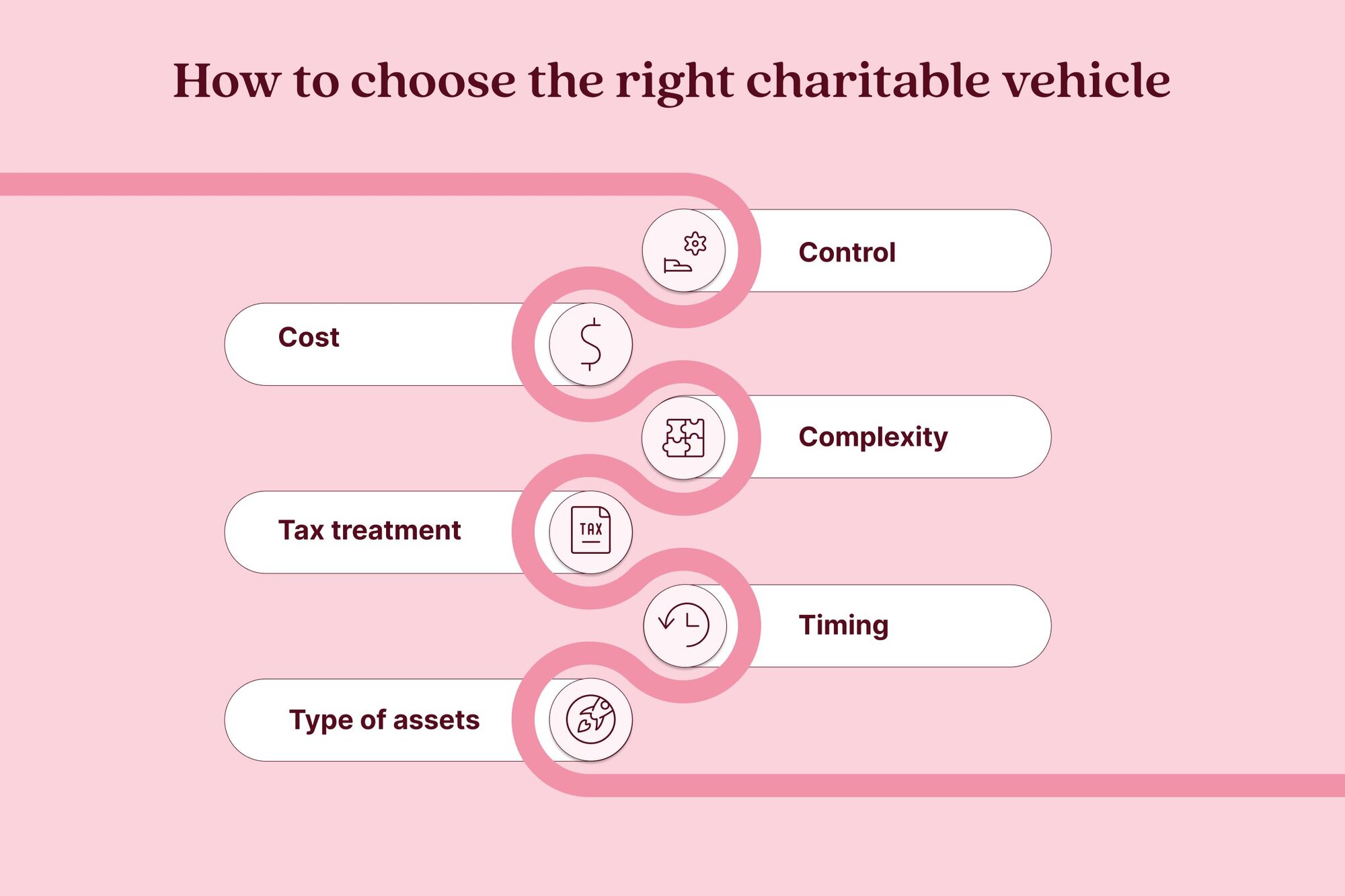
How to choose the right charitable vehicle
Here are things to consider when deciding how to narrow your options.
- Control: Would you like to guide future donations? DAFs and private foundations give you more influence than direct gifts.
- Cost: Direct gifts and QCDs are low-cost. Trusts and foundations require setup and administration.
- Complexity: Simpler options include bequests and beneficiary designations. CRTs and CLTs need professional oversight.
- Tax treatment: Some vehicles offer immediate income tax deductions, while others reduce estate taxes.
- Timing: Lifetime gifts can lower taxable income and provide immediate satisfaction. Testamentary gifts take effect after death.
- Type of assets: Appreciated assets, such as publicly traded securities or real estate, often deliver the best tax benefits when donated strategically.
Before you finalize your plan, speak with a financial advisor or tax professional to assess how each vehicle could reduce your tax burden and align with your estate goals.
Let’s now explore each of your options in greater detail so that you can choose with clarity.
Direct gifts and lifetime giving
Giving directly to qualified charitable organizations during your lifetime is one of the simplest and most fulfilling forms of charitable giving. These gifts can include cash contributions, appreciated assets, or tangible assets, depending on your portfolio.
Giving during your lifetime can provide immediate income tax benefits, such as an income tax charitable deduction that reduces your adjusted gross income in the year you make the gift. This is especially helpful if you’re itemizing deductions or looking to offset federal income tax on other gains.
On the other hand, giving through your estate plan can help reduce your taxable estate and potentially lower your estate tax liability, while creating a lasting legacy for the charitable organizations you care about. Many individuals choose to combine both approaches to balance present-day impact with long-term charitable goals.
Tip: When donating appreciated assets, giving directly to a charity typically yields a greater impact and better tax treatment than selling the asset and donating the proceeds.
Charitable bequests in a will or revocable trust
Bequests are among the most common forms of charitable donations made by an estate. Including a charity in your will or trust is a simple way to support causes you care about without affecting your income or assets during your lifetime.
There are three main types of charitable bequests.
- Specific amount bequest: "I leave $25,000 to [Charity Name]."
- Percentage bequest: "I leave 10% of my estate to [Charity Name]."
- Residuary bequest: "I leave the remainder of my estate, after other gifts and expenses, to [Charity Name]."
Charitable bequests qualify for an unlimited charitable deduction for estate tax purposes, which can significantly lower or eliminate estate taxes for large estates.
You can also leave your whole estate to charity, especially if you have no heirs or want to make a bold statement about your values. However, it’s important to consider how this might affect family members or executors and communicate your intentions clearly.
Retirement accounts and life insurance: Designating charitable beneficiaries
Retirement accounts and life insurance policies can be powerful tools in charitable estate planning. If you name a qualified charitable organization as a beneficiary on these accounts, the charity receives the full value without paying income taxes. Meanwhile, your estate may benefit from a charitable deduction, and your heirs are not burdened with paying income taxes on these assets.
This strategy is particularly useful for tax-deferred retirement accounts, such as IRAs. In fact, if you are aged 70½ or older, qualified charitable distributions allow you to donate up to $100,000 per year from your IRA directly to a qualified charity while still counting toward your required minimum distribution.
If these assets are left to family members, they may be treated as taxable income when withdrawn. But if left to a charity, there’s no income tax and no estate tax, which means the full value goes to the charitable cause.
Donor-advised funds
According to the IRS, a donor-advised fund is a separately identified fund or account that is maintained and operated by a section 501(c)(3) organization. It provides a flexible and low-maintenance way to manage your giving. You can make cash contributions, give appreciated assets, or even donate publicly traded securities. They allow you to receive an immediate income tax deduction and recommend grants to charities over time.
DAFs are popular because they offer:
An upfront charitable income tax deduction.
The ability to grow the charitable fund tax-free.
Ongoing flexibility; you can support different charitable organizations year after year.
Simpler recordkeeping compared to setting up a private foundation.
While you no longer control the fund after your contribution, most sponsors allow you to recommend how and when grants are made. This makes DAFs a practical middle ground between direct gifts and formal charitable trusts or foundations.
CRTs and CLTs
If you’re seeking a steady income stream for yourself or your family, a charitable remainder trust may be a viable solution. But, if you’d prefer that the charity receive income first and pass the remaining assets to your heirs later, consider a charitable lead trust. Both are powerful tools in charitable trust planning.
For a charitable remainder trust:
You contribute appreciated assets like stock or real estate.
You or your chosen beneficiaries receive income for life or a set term.
At the end of the term, the remaining assets go to charity.
You receive an immediate income tax deduction and may avoid capital gains taxes on the sale of assets.
With a charitable lead trust:
The charity receives income first for a period of time.
Your family members or heirs receive the remaining assets.
CLTs can reduce gift tax or estate tax liability and shift wealth to heirs at a lower tax cost.
These trusts are complex and typically require help from a financial advisor or estate planning attorney, but they offer significant tax benefits and control over your legacy.
Charitable gift annuities
A charitable gift annuity is a simple contract between you and a qualified charity. You donate cash or appreciated assets, and in return, the charity provides you (or a loved one) with fixed annual payments for life. After that, the remaining assets go to the charity to support its mission.
This option blends charitable giving with predictable retirement income. It’s especially helpful for those who want to support a cause and still maintain a steady income stream.
Tax benefits include:
- A partial income tax deduction in the year of the gift.
- A portion of each annuity payment may be tax-free for a period of time.
- If funded with appreciated stock, a portion of the capital gains taxes may be avoided or spread out.
Charitable gift annuities are a straightforward alternative to charitable trusts, offering peace of mind with their fixed payout structure. However, unlike a charitable remainder trust, the assets become the property of the charity upon funding and cannot be reversed.
Private foundations
A private foundation offers full control over how charitable funds are invested and distributed. It’s a formal structure, typically a nonprofit corporation or trust, that allows individuals or families to run their own charitable organization.
Private foundations are best suited for donors who:
Want to involve family members in decision-making.
Prefer to manage a long-term charitable fund.
Intend to give large amounts and need a structured way to support qualified charitable organizations and other causes.
However, private foundations come with added responsibility and cost. They must:
- File annual IRS Form 990-PF.
- Distribute at least 5% of assets each year to maintain tax-exempt status.
- Follow strict self-dealing and investment rules.
Unlike a donor-advised fund, a private foundation may also allow support for other charitable organizations that a DAF cannot easily fund, such as international charities or scholarship programs.
From a tax perspective, contributions may be limited to 30% of adjusted gross income for cash contributions and 20% for appreciated assets.
Assets and tax advantages
What you give can be just as important as how or when you give. Certain assets can unlock significant tax benefits when donated to qualified charitable organizations as part of your estate planning.
Giving publicly traded securities, real estate, or other appreciated assets can help you:
- Claim a charitable deduction for the fair market value
- Avoid capital gains taxes that would apply if you sold the asset yourself
- Reduce your taxable income if the gift is made during your lifetime
This makes appreciated assets one of the most tax-advantaged ways to give, especially when itemizing deductions.
Artwork, collectibles, and other tangible assets may qualify for a deduction, but only if the charity will use them in a way that’s related to its mission. If not, the deduction may be limited to your cost basis rather than the fair market value of the asset.
Retirement accounts can be used for charitable gifts, either through qualified charitable distributions or beneficiary designations, can bypass income taxes and estate taxes, allowing the full value to go to charity.
You can also designate a charity as the beneficiary to your life insurance policies.
Payments made directly to an institution
Sometimes, the most meaningful gift is one that directly helps a person you care about, like a grandchild’s tuition or a relative’s medical expenses. These types of payments are one way to avoid gift tax consequences and to preserve tax benefits.
Under IRS rules, if you make payments directly to an educational or medical institution, those amounts are not treated as taxable gifts, even if they exceed the annual gift tax exclusion limit.
According to publication 559, here’s what qualifies as gifts exempt from taxes:
- Tuition: Paid directly to a college, private school, or other qualifying institution (does not include books, supplies, or room and board)
- Medical expenses: Paid directly to a hospital or healthcare provider for diagnosis, treatment, or insurance premiums
Payments made to an institution on behalf of someone else generally do not qualify for a charitable deduction, unless the recipient is a qualified charitable organization. So, when structuring for tax efficiency:
- Make sure you pay the school or hospital directly, not the individual
- Keep detailed receipts and confirmations of payment
- Consider combining this strategy with other forms of charitable contributions if you also want to support causes you care about
Giving vehicle comparison chart (at-a-glance matrix)
Here’s a simplified guide comparing common charitable giving vehicles and their key features. Use this as a quick reference to match the right tools to your goals and assets.
| Giving vehicle | Setup cost & complexity | Donor control | Income stream | Deduction type | Capital gains avoidance | Ideal assets | Best for |
|---|---|---|---|---|---|---|---|
| Direct gift | Low | None | No | Immediate (if lifetime) | Yes (if appreciated assets) | Cash, appreciated stock | Simple gifts to qualified charitable organizations |
| Charitable bequest | Low to medium | Yes (via will) | No | Estate tax deduction | Yes | Any | Supporting causes after death while reducing the taxable estate |
| Donor-advised fund | Low to medium | Recommend only | No | Immediate | Yes | Cash, securities, mutual funds | Flexibility and ease of ongoing charitable contributions |
| Charitable remainder trust | High | Yes | Yes | Immediate (partial) | Yes | Appreciated stock, real estate | Income for life + charitable remainder |
| Charitable lead trust | High | Yes | To charity | Gift or estate deduction | Possibly | High-value assets | Shifting remaining assets to heirs with tax advantages |
| Charitable gift annuity | Medium | No | Yes (fixed) | Immediate (partial) | Partial | Cash or appreciated assets | Fixed income + support for charity |
| Private foundation | High | Full | No | Immediate (limited) | Limited | Large cash or stock gifts | Long-term family giving and complete control |
| Qualified charitable distribution | Low | Yes | No | Excluded from income | Yes | IRA funds | Donors over 70½, reducing taxable income and paying income taxes smartly |
| Beneficiary designation (IRA or life insurance) | Low | Yes (during life) | No | Estate tax deduction | Yes | Retirement accounts, insurance | Simple way to benefit a charity without changing your will |
What are income tax charitable deductions, and AGI limits?
Now you know that when you make charitable contributions during your lifetime, you are eligible for an income tax charitable deduction. This can reduce your adjusted gross income and lower your overall federal income tax.
AGI is your total gross income for the year, such as wages, dividends, capital gains, and retirement income, minus specific deductions like student loan interest or retirement contributions.
Deduction limits by gift type and recipient
- Cash contributions to qualified charitable organizations: Deduct up to 60% of AGI
- Appreciated assets like stocks: Deduct up to 30% of AGI
- Gifts to private foundations: Limited to 30% (cash) and 20% (appreciated assets)
- Excess amounts can generally be carried forward for up to five years
Standard deduction vs. itemized deductions
To benefit from a charitable deduction, you must itemize deductions on your tax return. In some years, Congress has passed temporary changes allowing above-the-line deductions for smaller cash gifts; however, these vary from year to year and should be confirmed with a tax professional.
Document your gifts
Keep bank records or written receipts for all donations.
Get a contemporaneous acknowledgment for gifts over $250.
For non-cash donations over $500, file IRS Form 8283.
Assets over $5,000 typically require a qualified appraisal.
A contemporaneous written acknowledgment is a written statement from a charity that donors must receive by the time they file their tax return (or by the return’s due date). This statement confirms a contribution of $250 or more and includes details such as the amount, date, and any goods or services rendered in return.
How to draft and document charitable gifts
No matter how thoughtful your charitable giving plan is, it’s only effective if the legal documentation reflects your intentions clearly. Whether you’re leaving charitable bequests, using a donor-advised fund, or making charitable donations from retirement accounts, attention to detail matters.
Use the charity’s legal name and EIN
Always identify the qualified charitable organization using its full legal name and EIN. Many charities have similar names, and using the wrong one could cause confusion or delays in receiving charitable contributions. You can verify this information using the IRS Tax-Exempt Organization Search tool.
Additionally:
- State the purpose of your gift (e.g., general use, scholarship fund, capital campaign)
- Include a backup language (called a cy-près clause) in case the charity merges, closes, or changes its mission.
Example: “If [Charity Name] no longer exists or cannot fulfill this gift, I direct my trustee to distribute the funds to a similar charitable organization.”
Align your documents: Will, trust, and beneficiary designations
Inconsistencies between your will, revocable trust, and beneficiary designations can create legal confusion or even cause litigation. For example, if your trust names one person, but your financial institution holds an outdated beneficiary form, the institution’s paperwork takes priority.
To help make sure there are no inconsistencies:
- Review all existing documents together (or with a financial advisor).
- Ensure your estate plan and financial account records agree.
- Keep copies of beneficiary designation forms and charitable gift clauses in one place.
Provide directions for custodians, trustees, and personal representatives
If you’re setting up a charitable remainder trust, lead trust, or private foundation, your trustee must understand the structure and their duties. Provide them with:
- Copies of formation documents and tax IDs
- A summary of your intent and instructions for charitable beneficiaries
- Access to professionals for legal and tax compliance
For simpler gifts (like QCDs, DAFs, or direct bequests), your personal representative or executor should know which assets will go to charity and have access to gift instructions, contact information for charities, and any relevant tax documentation. This kind of planning not only honors your wishes but also can reduce delays, tax liability, and family disputes.
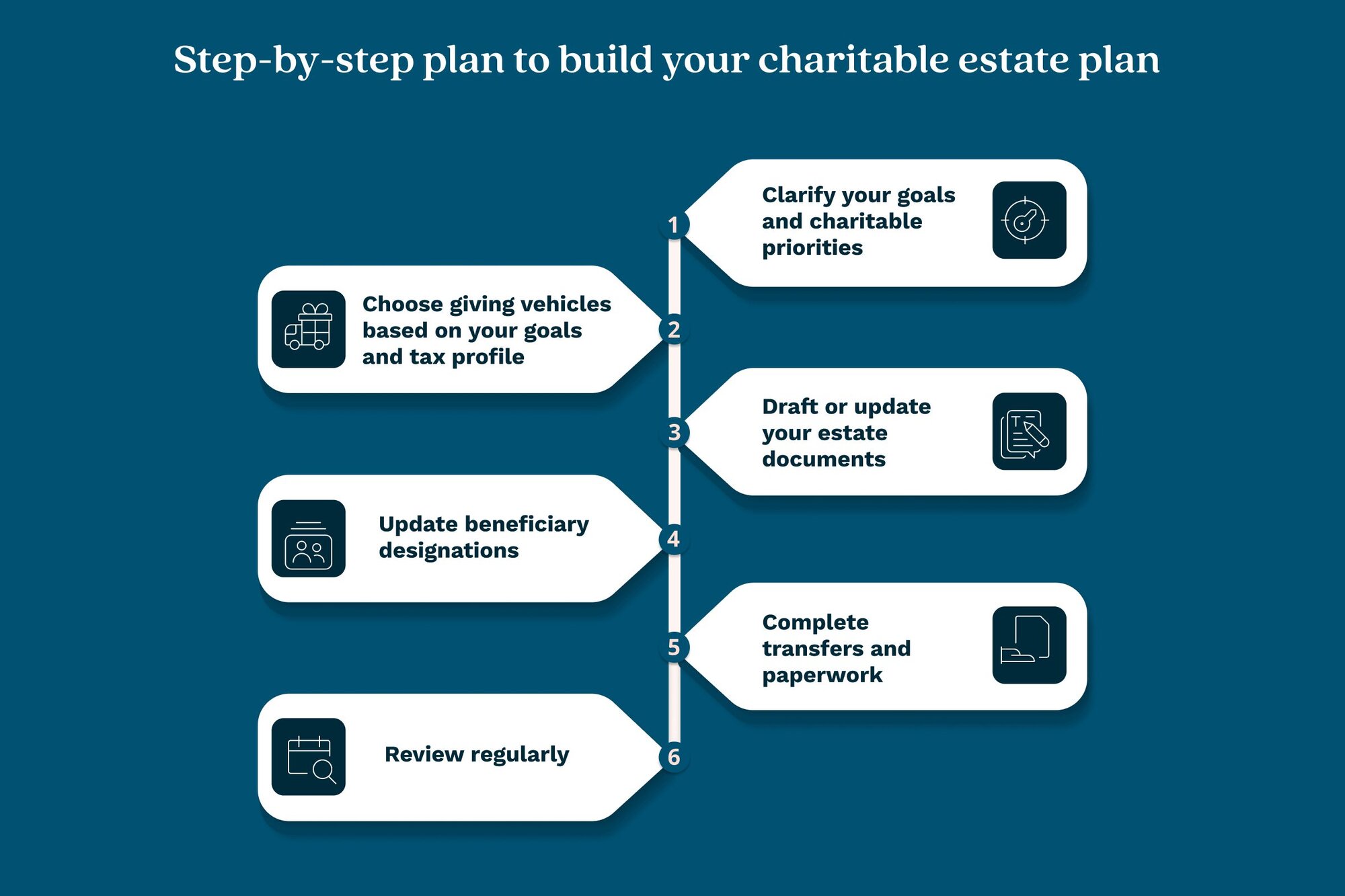
Build your charitable estate plan: Step by step
Ready to get started? Here’s a streamlined action plan that walks you through the core steps of charitable estate planning, whether your goals are small or ambitious.
Step 1: Clarify your goals and charitable priorities
You can start by asking yourself the following questions:
- Which causes or charitable organizations matter most to me?
- Do I want to give now or later?
- What assets make the most sense to give?
Also, think about family members, heirs, and what balance you’d like to strike between them and your charitable beneficiaries.
Step 2: Choose giving vehicles based on your goals and tax profile
Pick strategies that align with your needs. For example, some people who value simplicity for themselves above all else prefer direct gifts or charitable bequests, while others who want flexibility and the option to preside over decisions may choose donor-advised funds.
Whatever you choose, make sure to match your choices to your income tax, estate tax, and capital gains tax planning needs.
Step 3: Draft or update your estate documents
When you draft your documents, it’s important to When drafting your documents:
- Add clear charitable bequests to your will or revocable trust
- Include backup language and purpose restrictions if needed
- Coordinate with any existing trusts, DAFs, or private foundations
Step 4: Update beneficiary designations and complete transfers and paperwork
Check every retirement plan, annuity, or life insurance policy. Submit updated forms to your financial institution, using the full legal name and EIN of the charity. Keep the most current copies all together with any other estate documents so there is no confusion as to which documents actually fulfill your wishes.
Step 5: Complete transfers and paperwork
Don’t just create a plan. For anything that’s not an account with a beneficiary, you’ll also need to:
- Fund trusts, DAFs, or gift annuities if needed
- Collect gift receipts, letters of acknowledgment, and qualified appraisals for non-cash gifts
- For QCDs, ensure the IRA custodian sends the gift directly to the charity
Step 6: Review regularly
Life changes, so should your plan. Revisit your charitable estate plan after:
- Major family events (marriage, divorce, new children)
- Large financial changes
- Tax law updates that may affect your deductions or taxable estate
Keep your plan current to ensure your charitable assets go where you intend and that you continue to benefit from available tax advantages.

What challenges and considerations should you be aware of with charitable giving in estate plans?
Charitable giving can have a meaningful impact on your estate plan, but it also brings important legal, practical, and emotional considerations. So, it’s crucial to plan carefully and revisit your decisions over time.
Family dynamics and potential conflicts
Charitable giving after death can sometimes create tension among family members, especially if they were unaware of your intentions or feel excluded from the estate planning process. This is especially true when you’re leaving a large portion, or your entire estate, to charity. Open communication, clear documentation, and early family involvement in your charitable vision can help prevent disputes or misunderstandings.
Consider setting up a donor-advised fund or a private foundation, where family members can collaborate to carry out your wishes.
Legal and administrative challenges
The structure and management of charitable gifts, particularly through tools such as charitable remainder or charitable lead trusts, can be complex. These arrangements require ongoing administration, annual filings, and clear compliance with IRS rules. Without proper guidance, there's a risk of errors in trust administration, which could jeopardize the intended charitable deduction or delay the distribution of assets. Always consult with an experienced estate planning attorney or tax professional when setting up a charitable trust.
Need for periodic reviews and updates
Your values may evolve, family dynamics may shift, and charitable organizations may change over time. That’s why it’s essential to review your estate plan every few years or after any major life event. Review the structure of any perpetual trust for charitable giving, verify beneficiary designations, and ensure that your documents accurately reflect your current intentions. Regular updates can also help you stay compliant with changing tax laws, especially those that impact charitable giving after death.
Why use LegalZoom for charitable giving documents and templates
Planning for charitable gifts can feel overwhelming, especially when you're managing estate planning, beneficiary designations, and ever-changing tax rules. That’s where LegalZoom can help.
Whether you want to include charitable bequests, update your revocable trust, or name a qualified charitable organization as a beneficiary, LegalZoom’s platform simplifies the process and gives you access to attorneys if you need one.
Hassle-free and secure
Start your estate plan from the comfort of your own home, without scheduling in-person lawyer visits. LegalZoom walks you through simple questions to help you:
- Choose charitable beneficiaries
- Identify charitable assets to donate
- Structure your plan to minimize estate taxes, income taxes, and gift tax exposure
Attorney-supported and state-compliant
LegalZoom’s documents are reviewed by attorneys and accepted in all 50 states. You can create your estate plan independently or opt to review it with a licensed estate planning attorney from our network.
"It's wonderful that a lawyer is available to review all documents and answer questions."
—Rose G., LegalZoom estate plan customer
Built for real-life giving strategies
With LegalZoom, you can:
- Create a will that includes charitable donations
- Set up a trust that aligns with charitable remainder trusts, lead trusts, or private foundations
- Assign beneficiary designations for your retirement accounts or life insurance
- Use our rich editor to insert purpose clauses, backup charity language, and tax-advantaged bequest templates
We’ve helped create over 2.4 million estate planning documents, trusted by families, donors, and planners for more than 20 years.
FAQs about charitable giving
How do income tax deduction limits apply to appreciated stock and other assets?
Donations of appreciated assets, such as publicly traded securities, are typically deductible at fair market value, up to 30% of your adjusted gross income, when given to public charities. You must itemize deductions and comply with IRS documentation rules, including appraisals for larger gifts. One can carry forward excess deductions for up to five years.
Can I use a QCD to fund a DAF or private foundation?
No. QCDs from IRAs must go directly to a qualified public charity. They cannot be used to fund donor-advised funds, private foundations, or supporting organizations. Using a QCD improperly may result in the amount being treated as taxable income.
What happens if a named charity merges or dissolves?
Your plan should include backup language (cy-près clauses) that allows your executor or trustee to redirect the gift to a similar charity with a comparable mission. Without this, the gift could lapse or require court intervention. LegalZoom's customizable templates make it easy to add this language.
How do I coordinate charitable beneficiaries with family bequests?
List your goals clearly, including who gets what and why. Then structure your plan accordingly using:
- Charitable bequests for legacy giving
- Trusts for a balance between family and charity
- Beneficiary designations to keep charitable gifts outside probate
Align everything across your will, trust, and account paperwork to ensure your plan is consistent and enforceable.
How can I maximize tax benefits through charitable giving?
To maximize tax benefits, choose giving strategies that align with your financial profile and timing. Donating appreciated assets like publicly traded stock or real estate allows you to avoid capital gains taxes and claim a fair market value charitable deduction, typically up to 30% of your adjusted gross income. Cash gifts to qualified charitable organizations may be deductible up to 60% of AGI. If you're 70½ or older, you can make QCDs directly from your IRA to charity, reducing your taxable income without affecting itemized deductions.
For long-term planning, consider combining lifetime giving (which offers income tax benefits) with charitable bequests in your will or trust to reduce your taxable estate. Tools like donor-advised funds, charitable remainder trusts, and charitable lead trusts can also provide ongoing impact while offering deductions, income streams, and estate tax savings. To preserve these benefits, keep proper documentation, file the required IRS forms, and consult a tax professional to tailor your plan effectively.
How does charitable giving impact heirs and family dynamics?
Charitable giving can positively shape your legacy, but some family members may be surprised or concerned if charitable bequests significantly reduce their inheritance. To avoid misunderstandings, it’s helpful to communicate your intentions clearly in advance and explain your reasons for supporting specific charitable organizations.
From a financial perspective, donating retirement accounts, appreciated assets, or portions of your estate to charity can reduce your taxable estate, potentially benefiting your heirs by lowering or eliminating estate taxes. You can also structure your plan to support both family and charity, for example, by using a charitable lead trust to provide immediate income to a charity and later transfer the remaining assets to heirs at a reduced gift-tax cost. With the right balance, you can preserve family harmony while making a lasting impact.
'%20/%3e%3c/svg%3e)

'%3e%3cpath%20fill-rule='evenodd'%20clip-rule='evenodd'%20d='M9.31239%2025.5316H13.0679V14.1032H9.31239V25.5316ZM11.1913%208.46875C9.93945%208.46875%209%209.25086%209%2010.505C9%2011.5995%209.78211%2012.5389%2011.1913%2012.5389C12.6005%2012.5389%2013.3826%2011.5995%2013.3826%2010.505C13.3826%209.4082%2012.6005%208.46875%2011.1913%208.46875ZM27%2018.9577V25.5316H23.2445V19.4275C23.2445%2017.8609%2022.6174%2016.7664%2021.3679%2016.7664C20.2711%2016.7664%2019.644%2017.5463%2019.3316%2018.1756C19.1743%2018.488%2019.1743%2018.8004%2019.1743%2019.1128V25.5316H15.4165V13.9458H19.1743V15.5123C19.644%2014.7302%2020.5835%2013.6357%2022.6174%2013.6357C25.1234%2013.7908%2027%2015.3573%2027%2018.9577Z'%20fill='white'/%3e%3c/g%3e%3cdefs%3e%3cclipPath%20id='clip0_952_9489'%3e%3crect%20width='18'%20height='18'%20fill='white'%20transform='translate(9%208)'/%3e%3c/clipPath%3e%3c/defs%3e%3c/svg%3e)



