




Starting a nonprofit in Maryland means navigating multiple legal processes with different state and federal agencies. First, you must form a nonprofit corporation under Maryland state law, then you can obtain 501(c)(3) status from the Internal Revenue Service (IRS). Maryland also requires registration with the Secretary of State's Charitable Organizations Division before you can solicit any donations.
This guide covers how to start a nonprofit in Maryland, including all formation steps, what to expect along the way, common roadblocks, and how to stay compliant in the future.
Nonprofit vs. 501(c)(3): What is the difference?
A nonprofit corporation is a state-level legal business entity formed under Maryland law. It protects directors and officers from personal liability for the organization's debts. It does not make your organization tax-exempt or entitle donors to deduct their contributions.
501(c)(3) is a federal tax-exempt designation granted by the IRS to qualifying nonprofits. This status allows you to accept tax-deductible donations, qualify for most charitable grants, and avoid federal income tax on revenue tied to your charitable mission. 501(c)(3) does not apply to state taxes—you will need to apply for state tax exemptions separately.
You can be a nonprofit without having federal tax-exempt status, though most charitable organizations want both.
How to start a nonprofit in Maryland: Step by step
Step 1: Choose a name for your nonprofit
The first step in forming a business is coming up with an appropriate name.
Your name must meet Maryland's requirements. It should contain "Corporation," "Incorporated," "Limited," or their abbreviations, and must be distinguishable from organizations already on record.
Use the Maryland Business Express entity search tool at SDAT or the LegalZoom name check tool below to confirm availability before you file. For more information, read our comprehensive guide to Maryland business names.
Free Maryland Business Name Check
Starting a business? Use our free tool to check your business name against the Maryland Department of Assessments & Taxation records.
By clicking "Check Availability," I agree to LegalZoom's Terms of Use. This search is a preliminary check of state databases and does not include variations or trademarks. Results do not guarantee name availability or compliance with legal requirements.
Step 2: Choose your incorporators, initial directors, and officers
Incorporators sign and file the articles of incorporation. One or more individuals can serve; the only requirement is that they be at least 18 years old. The incorporator's role ends once the articles are accepted.
Directors form your board and govern the organization after incorporation. Maryland requires at least one director, but that is the legal floor, not a practical target. The IRS scrutinizes thin boards during 501(c)(3) review, and most grant funders require evidence of independent oversight. Recruit at least three unrelated directors before applying for tax-exempt status.
Officers handle day-to-day operations, typically a president, secretary, and treasurer. Maryland law does not require officers to be separate from directors, but keeping those roles distinct is standard governance practice and signals organizational seriousness to grant-makers and auditors.
Step 3: Appoint a Maryland resident agent
A resident agent (also called a registered agent) receives legal notices, service of process, and government correspondence on behalf of your nonprofit.
Your registered agent must have a Maryland street address, be available during normal business hours, and be either a Maryland resident or a business entity authorized to do business in Maryland. You can serve as your own registered agent, appoint someone you know, or hire a commercial service.
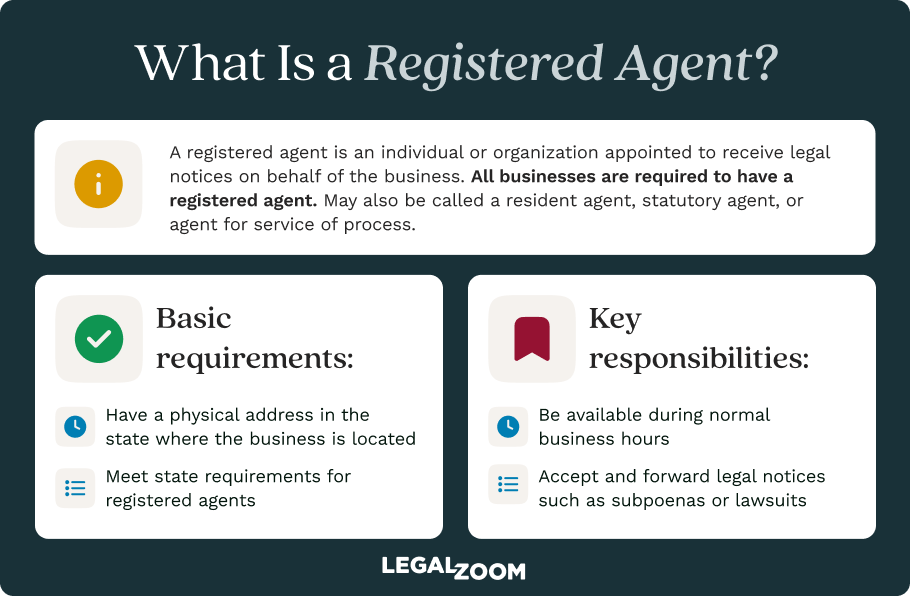
The registered agent's name and Maryland address become public information, as they must appear in your articles of incorporation. Many nonprofits choose to hire a professional registered agent service if they don’t want their address public or cannot be at the registered office during all standard business hours.
Step 4: File Maryland articles of incorporation
File the Articles of Incorporation for a Tax-Exempt Nonstock Corporation with SDAT, not the Secretary of State.
Your articles of incorporation must include the following:
- Incorporator name(s) and address(es)
- Organization name (with required designator)
- Purpose statement
- Registered agent name and Maryland street address
- The number of directors the nonprofit will have
- Signatures of the incorporator and registered agent
Additionally, the IRS reviews your articles when you apply for 501(c)(3) status. If any of the following three clauses are missing, the IRS will reject your application regardless of how thoroughly you completed Form 1023.
- Charitable purpose statement: Your articles must state that the organization is organized exclusively for one or more purposes recognized under IRC Section 501(c)(3). A vague or overly broad purpose statement raises red flags during IRS review.
- Private inurement prohibition: Your articles must explicitly state that no part of net earnings will be used for the benefit of any private shareholder or individual.
- Dissolution clause: Your articles must specify that upon dissolution, remaining assets will be distributed to another 501(c)(3) organization or a federal, state, or local government entity for a public purpose.
Tip: If you use Maryland's standard form, the required tax-exempt language is already included. If you draft custom articles, confirm all three clauses are present before filing.
Filing costs at least $170 in combined state fees: a $100 base filing fee, a $20 organization and capitalization fee, and $50 to the Maryland Not-For-Profit Development Center Fund. Standard review takes 6–8 weeks. Expedited review within 7–10 business days requires an additional $50, and same-day service is available for an additional $325 when filed online by 2:30 p.m.
You can file online through Maryland Business Express, by mail, or in person. Always verify current fees and processing times directly with SDAT before filing. If not filing online, include a check made payable to SDAT.
Step 5: Draft nonprofit bylaws and hold your first board meeting
Bylaws are your organization's internal governance rules. Maryland does not require you to file them with the state, but the IRS requires them as part of your Form 1023 application.
Your bylaws should address the following:
- Organization name and charitable purpose
- Board size, composition, and term lengths
- Officer roles and responsibilities
- Meeting frequency and quorum requirements
- Voting procedures
- Conflict of interest policy
- Procedures for amending the bylaws
- Dissolution procedures
IRS Form 1023 asks specifically whether your organization adopted a conflict of interest policy, and a "no" answer invites additional scrutiny. It does not have to be elaborate, but it must exist in writing and be formally adopted. You should treat it as mandatory.
After incorporation, hold your initial organizational meeting to approve the bylaws, elect officers, adopt key policies, approve the application of an employer identification number (EIN) and opening of a bank account. The board should also authorize filings for IRS and state tax exemptions. Make sure to document all decisions in meeting minutes signed by the secretary.
Step 6: Obtain an EIN
An EIN is your organization's federal tax identification number. You need it to open a bank account, hire employees, and submit your 501(c)(3) application.
You can apply for free online at IRS.gov or use an EIN service like LegalZoom if you want this task taken off your plate..
Step 7: Apply for federal 501(c)(3) tax-exempt status
You'll file either Form 1023-EZ or the standard Form 1023, both submitted electronically through pay.gov. For a deeper look at the application process, see LegalZoom's guide to applying for 501(c)(3) tax-exempt status.
- Use Form 1023-EZ if you project gross receipts of $50,000 or less in each of the next three years and hold total assets of $250,000 or less. The fee to file is $275 and the typical processing time is 2–4 weeks.
- Use Form 1023 (standard) for larger or more complex organizations. The fee to file is $600, and the processing time is typically about six months or longer if the IRS requests additional information.
Once approved, the IRS issues a determination letter confirming your 501(c)(3) status. Keep it as donors, grantmakers, and banks will ask for it repeatedly. This step can be tricky—for personalized help with your 1023-EZ, use LegalZoom’s 501(c)(3) filing service.
Note: 501(c)(3) status is typically retroactive to your date of incorporation, but only if you file within 27 months of formation. Missing that window can leave your organization unrecognized as tax-exempt for the period between incorporation and approval.
Step 8: Apply for Maryland state tax exemption
Federal 501(c)(3) recognition does not automatically exempt your organization from Maryland state taxes. Apply for Maryland state income tax exemption through the Maryland Tax Connect portal.
Maryland nonprofits with 501(c)(3) status may also qualify for exemption from Maryland sales and use tax, which requires a separate certificate from the Comptroller. This certificate will not apply retroactively to purchases made before you obtained it. You can apply through the same portal for both exemptions.
Make sure to verify current processing times and documentation requirements directly with the Maryland Comptroller.
Step 9: Register for charitable solicitation in Maryland
Before your Maryland nonprofit asks anyone for a donation, whether it be through a fundraising event, social media post, crowdfunding campaign, or direct mail appeal, you must register with the Maryland Secretary of State's Charitable Organizations Division. You can have all your state and federal paperwork in order and still be out of compliance if you skip this step.
Registration is required before you begin soliciting. Maryland defines "solicitation" broadly: Phone calls, texts, social media, emails, direct mail, and in-person requests all qualify.
- A charitable organization must annually register if gifts exceed $25,000 or if it uses a professional solicitor. Because you will not know in advance whether you will hit that threshold, register and receive confirmation before beginning any solicitation activities. Do not wait to see how much you raise.
- If your organization's gifts do not reach $25,000 and you do not employ a professional solicitor, you must still file an exempt notice. Skipping it entirely is a violation of the Maryland Charitable Solicitations Act regardless of how little you raise.
- Some organizations are fully exempt from registration, including religious organizations, educational institutions, hospital foundations, veterans' organizations chartered under federal law, and certain volunteer and emergency services organizations.
If you believe your organization qualifies for an exemption, submit supporting documentation to the Charitable Organizations Division and wait for their confirmation before fundraising begins. For an in-depth look, see the Secretary of State’s explainer.
Maryland nonprofit annual compliance requirements
Forming your nonprofit and securing tax-exempt status are one-time milestones. Staying compliant is ongoing. Missing any recurring obligation can cost you your corporate charter, your tax-exempt status, or your authorization to fundraise.
SDAT annual report
Maryland requires all nonprofits to submit a Maryland Annual Report to SDAT by April 15 each year. File online through Maryland Business Express or by mail. Nonprofits pay no filing fee.
Do not treat the zero-dollar fee as a reason to skip it. Failure to file can result in revocation of your corporate charter, eliminating the legal structure that protects your directors and officers from personal liability.
IRS Form 990
Most 501(c)(3) organizations must file an annual information return with the IRS by the 15th day of the 5th month after the end of their accounting period, which is May 15 for calendar-year nonprofits. The proper 990 form will depend on your organization’s gross receipts.
- Form 990-N (e-Postcard): Annual gross receipts normally $50,000 or less.
- Form 990-EZ: Gross receipts under $200,000 and total assets under $500,000.
- Form 990: Required for organizations exceeding the Form 990-EZ thresholds.
Failing to file for three consecutive years results in automatic revocation of tax-exempt status. Revocation means donors can no longer deduct contributions and you lose the federal income tax exemption. Reinstatement requires reapplying to the IRS.
All Form 990 filings must be made publicly available upon request and are searchable through the IRS tax exempt organization search. Donors, grant-makers, and journalists routinely pull them before giving or granting. Treat your 990 with the same care you would give a grant application. For guidance on what this ongoing obligation entails, check out LegalZoom’s article on maintaining tax-exempt status in a nonprofit.
Charitable solicitation registration renewal
Maryland requires annual renewal of your charitable solicitation registration. The deadline falls within 10.5 months after your fiscal year ends. If your organization crosses a contribution threshold that moves you from being exempt to filing the full form, then you will need to update your registration accordingly.
State tax filings with the Maryland Comptroller
If your organization generates unrelated business income, that income may be subject to Maryland income tax even if your organization is otherwise tax-exempt. Confirm with the Maryland Comptroller whether any state tax filings apply.
How much does it cost to start a nonprofit in Maryland?
| Formation step | Agency | Government fee |
|---|---|---|
| Articles of incorporation | Maryland SDAT | $170 |
| 501(c)(3) application—standard | IRS | $600 |
| 501(c)(3) Application—streamlined | IRS | $275 |
| Charitable solicitation registration (under $25,000 raised) | Maryland Secretary of State | $0 |
| Charitable solicitation registration ($25,000+ raised) | Maryland Secretary of State | $50–$300, based on contribution levels |
How long does it take to start a nonprofit in Maryland?
The state-level steps move relatively quickly. The federal 501(c)(3) review is where most timelines stretch.
| Form | Estimated timeline |
|---|---|
| Articles of incorporation—standard | 6–8 weeks |
| Articles of incorporation—expedited | 1–2 weeks |
| IRS Form 1023-EZ | 2–4 weeks |
| IRS Form 1023 (long form) | 3–6+ months |
| Maryland charitable solicitation registration | 6–8 weeks |
| Maryland Comptroller | Varies |
Start your Maryland nonprofit with LegalZoom
Starting a nonprofit involves more paperwork, more agencies, and more sequencing decisions than most founders anticipate. LegalZoom has helped more than 100,000 nonprofits get started, and nonprofit formation is one of the most detail-intensive processes we support.
Simple mistakes can delay or block your 501(c)(3) application. LegalZoom's formation process is designed to catch those issues before they become problems. When you’re ready to file your IRS Form 1023-EZ, turn to LegalZoom’s 501(c)(3) filing service.
FAQs about starting a nonprofit in Maryland
Can I pay myself if I run a nonprofit?
Yes, subject to certain conditions. Nonprofit founders and executives can receive reasonable compensation for services rendered. The IRS requires that compensation be "reasonable and not excessive" compared to what similar organizations pay for similar services.
You cannot distribute profits or surplus funds to yourself as an owner or shareholder. Excessive compensation can jeopardize 501(c)(3) status and trigger IRS penalties known as intermediate sanctions.
Can I start a nonprofit by myself?
You can be the sole incorporator, and Maryland law technically requires only one director. However, the IRS scrutinizes single-person or family-dominated boards during its review because they raise concerns about private benefit and lack of independent oversight. Best practices would have at least three unrelated directors before applying for 501(c)(3) status.
What is the 5% rule for nonprofits?
The 5% rule applies to private foundations, which must distribute at least 5% of their investment assets annually for charitable purposes. It does not apply to public charities, the most common type of 501(c)(3). If your Maryland nonprofit qualifies as a public charity, the 5% distribution requirement does not apply to you.
'%20/%3e%3c/svg%3e)

'%3e%3cpath%20fill-rule='evenodd'%20clip-rule='evenodd'%20d='M9.31239%2025.5316H13.0679V14.1032H9.31239V25.5316ZM11.1913%208.46875C9.93945%208.46875%209%209.25086%209%2010.505C9%2011.5995%209.78211%2012.5389%2011.1913%2012.5389C12.6005%2012.5389%2013.3826%2011.5995%2013.3826%2010.505C13.3826%209.4082%2012.6005%208.46875%2011.1913%208.46875ZM27%2018.9577V25.5316H23.2445V19.4275C23.2445%2017.8609%2022.6174%2016.7664%2021.3679%2016.7664C20.2711%2016.7664%2019.644%2017.5463%2019.3316%2018.1756C19.1743%2018.488%2019.1743%2018.8004%2019.1743%2019.1128V25.5316H15.4165V13.9458H19.1743V15.5123C19.644%2014.7302%2020.5835%2013.6357%2022.6174%2013.6357C25.1234%2013.7908%2027%2015.3573%2027%2018.9577Z'%20fill='white'/%3e%3c/g%3e%3cdefs%3e%3cclipPath%20id='clip0_952_9489'%3e%3crect%20width='18'%20height='18'%20fill='white'%20transform='translate(9%208)'/%3e%3c/clipPath%3e%3c/defs%3e%3c/svg%3e)



