



Starting a Michigan nonprofit requires two separate processes: incorporating as a domestic nonprofit corporation with the Michigan Department of Licensing and Regulatory Affairs (LARA), then applying separately for federal 501(c)(3) status with the IRS.
This guide covers every step of forming a nonprofit in The Great Lakes State, from choosing a nonprofit name and selecting your board to filling out your articles of incorporation and registering for state and federal taxes.
What is a Michigan nonprofit corporation?
A Michigan nonprofit corporation, formed under the Michigan Nonprofit Corporation Act, is an entity created for any lawful purpose that does not involve financial gain for its owners, board members, or shareholders. Michigan nonprofits typically form for charitable, educational, religious, or mutual benefit purposes.
It’s important to note that state incorporation is separate from federal 501(c)(3) status. LARA recognizes your nonprofit as a legal entity, while the IRS decides whether you qualify for federal tax exemption and deductible donations. You need both to operate as a fully tax-exempt charity.
Nonprofit vs. LLC in Michigan: Which structure fits your mission?
A Michigan nonprofit corporation and a Michigan LLC both register with LARA but serve different purposes. An LLC generates profit for its owners; a nonprofit must direct revenue toward its mission, with no profits flowing to founders, directors, shareholders, or members.
Note: The IRS allows nonprofit corporations to pay officers and key employees “reasonable compensation.”
Only nonprofit corporations can qualify for federal 501(c)(3) status. So if you want tax-deductible donations or grants, choose a nonprofit corporation. If you want a mission-driven business that can generate profits, consider an LLC.
Here’s a quick overview of the differences between a Michigan nonprofit and an LLC.
| Feature | Michigan nonprofit corporation | Michigan LLC |
|---|---|---|
| Purpose | Charitable, educational, religious, or mutual benefit mission | Generating profit for members |
| Profit distribution | Prohibited—revenue must further the mission | Permitted—based on operating agreement |
| 501(c)(3) eligibility | Yes | No |
| Tax-deductible donations | Yes, with 501(c)(3) approval | No |
| Grant eligibility | Yes; private and government grants | Yes; typically limited to small business grants |
| Personal liability protection | Yes, for directors and officers | Yes, for members |
| Governing document | Articles of incorporation + bylaws | Articles of organization + operating agreement |
Step 1: Choose a name for your Michigan nonprofit
Your nonprofit’s name is the first thing that people will see, so it’s important to choose one that communicates your organization’s mission and values. There are a few things to keep in mind when naming your Michigan nonprofit:
- The name needs to be distinguishable, meaning that it can't duplicate or closely resemble any name already on file with LARA, including reserved, registered, or assumed names.
- Michigan requires a corporate designator: "Incorporated," "Corporation," "Company," or "Limited," or an accepted abbreviation ("Inc.," "Corp.," "Co.," "Ltd."). Leave it off, and your filing will likely get rejected.
- Words like "bank" or "insurance" need regulatory approval, and your name can't imply a government connection or contradict your charitable purpose.
Perform a Michigan business name check using our tool below or search LARA's business portal. If the name you enter is already taken, you’ll need to come up with a different option.
Free Michigan Business Name Check
Starting a business? Use our free name check tool to check your business name against Michigan's official records.
By clicking "Check Availability," I agree to LegalZoom's Terms of Use. This search is a preliminary check of state databases and does not include variations or trademarks. Results do not guarantee name availability or compliance with legal requirements.
It’s also recommended you perform a trademark search to check both state and federal trademarks and ensure that your nonprofit name doesn’t infringe on a trademarked name. If you’ve decided on a name but are not quite ready to form your nonprofit, you can reserve it for 180 days by submitting an application for reservation of name with LARA. The filing fee is $10.
Read more about naming your nonprofit in our comprehensive guide to Michigan business names.
Step 2: Appoint a registered agent
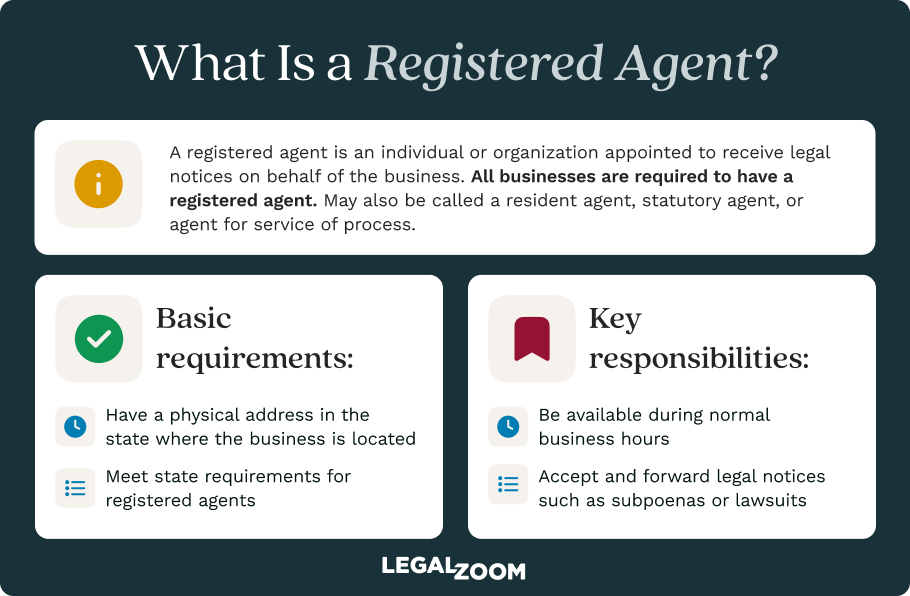
Every Michigan nonprofit must designate and maintain a registered agent: a person or entity that receives legal documents and government correspondence on the organization’s behalf.
Your agent's name and address are required on your articles of incorporation. The agent needs a physical Michigan street address (not a P.O. box) and must be reachable during business hours.
Who can serve as a registered agent for a Michigan nonprofit?
Your agent can be a Michigan resident, a domestic corporation authorized in Michigan, or an authorized foreign corporation with a matching Michigan office. You can’t name your nonprofit entity as its own agent, but the nonprofit’s owner, a board member, or an employee can serve in this role.
The registered agent must provide a physical address where they can be reached during normal business hours. This address becomes public record. Those who work from home or from the road may want to appoint a professional registered agent to ensure privacy and timely delivery of important documents.
Step 3: Recruit your board of directors and hold an organizational meeting
Before you file articles of incorporation, you’ll need to form your board, which manages your nonprofit's affairs and mission, and have the first organizational meeting.
Michigan board requirements
Michigan law requires at least three directors, but they don’t necessarily need to live in the state. Your board should have an odd number of board members to avoid tie votes.
Michigan nonprofits can organize on a directorship basis (the board elects its own successors) or a membership basis (outside members vote on board elections). Your bylaws set terms and removal procedures for the board.
The organizational meeting
The first board meeting should include the following:
- Seating initial directors and confirming acceptance
- Electing officers (such as president, secretary, treasurer)
- Adopting bylaws and a conflict of interest policy
- Authorizing an officer to apply for an employer identification number (EIN)
- Authorizing the articles of incorporation filing
Make sure to document everything in meeting minutes. The IRS may ask for documentation of key board decisions, so keep meticulous records, whether the board acts by meeting or unanimous written consent.
Note: Under MCL 450.2485, Michigan nonprofits are required to keep books, records, and meeting minutes and make them available to members, directors, and committees when requested.
Step 4: Draft bylaws and a conflict of interest policy
Bylaws work alongside your articles to spell out governance procedures and can include any provision that doesn't conflict with the law or your articles. LARA doesn't require filing bylaws, but Michigan law requires you to adopt them. The IRS will ask for them—and your conflict of interest policy—in your 501(c)(3) application.
Michigan nonprofit bylaws
Your bylaws should cover:
- Your stated purpose, matching your articles and intended 501(c)(3) purpose, and directorship- or membership-basis status
- Director count (minimum of three), qualifications, terms, and election/removal procedures
- Officer titles (president, secretary, treasurer at a minimum), election, and vacancy procedures
- Meeting frequency, notice requirements, and quorum thresholds
- Conflict of interest disclosure and abstention procedures
- Financial oversight procedures, including the nonprofit’s fiscal year, audits, non-inurement, and signature authority for expenditures
- Indemnification protecting directors and officers acting in good faith
- Recordkeeping and bylaw amendment procedures
- A dissolution clause stating the plan for nonprofit assets in the event of dissolution
Note: The IRS requires a purpose, inurement, conflict of interest, and dissolution clauses for 501(c)(3) approval.
Conflict of interest policy
This is a separate, board-adopted document that must exist before you file for federal 501(c)(3) status. It must define and set a process for handling conflicts and require any relevant disclosure by directors, officers, and key employees. You can use the IRS’ sample copy to form your conflict of interest policy.
Step 5: File articles of incorporation with LARA
Filing articles of incorporation makes your nonprofit a legal entity in Michigan.
What your articles of incorporation must include
Michigan nonprofit articles of incorporation need to include the following:
- The organization's name and purpose
- A statement on whether the nonprofit corporation has members (directorship or membership basis)
- Asset value/description, financing method, and confirmation of structure
- Registered agent's name and street and mailing address
- Name and address of each incorporator
The IRS provides sample copy of articles of incorporation that meet their requirements for 501(c)(3) status.
Filing methods through Michigan LARA
There are several filing methods available:
- Online. Create an MiLogin for Business account. Then, follow the instructions to file nonprofit articles of incorporation.
- By mail. Send completed Form CSCL/CD-502 with a check or money order payable to the State of Michigan to the address listed on the form.
- In person. Deliver the completed Form CSCL/CD-502, along with payment, to LARA's Corporations Division office at 2407 N Grand River Ave, Lansing, MI 48906.
Filing fees and processing times
LARA offers several application processing options.
| Processing time | Total fee |
|---|---|
| Standard processing (about 10 business days) |
$20 |
| 24-hour expedited | $70 |
| Same-day expedited | $120 |
| 2-hour expedited | $520 |
| 1-hour expedited | $1,020 |
Step 6: Get an EIN from the IRS
Once LARA issues your certificate of incorporation, apply for an employer identification number (EIN). It’s like your organization's equivalent of a Social Security number. You'll need it to open business bank accounts, hire employees, and submit your 501(c)(3) application. Your EIN is permanent regardless of future business name or address changes.
You can apply for an EIN with LegalZoom or do it yourself using the IRS’ EIN application.
Step 7: Apply for federal 501(c)(3) tax-exempt status
Federal 501(c)(3) status lets your nonprofit accept tax-deductible donations and apply for most grants. Remember that registering a nonprofit with LARA doesn't grant your organization federal tax-exempt status; the IRS decides based on your purpose, governance, and finances.
The IRS form you use depends on your nonprofit’s size.
- Form 1023 (standard): Required if you expect more than $50,000 in annual gross receipts during any of your first three years. The filing fee is $600.
- Form 1023-EZ (streamlined): For organizations expecting $50,000 or less in annual gross receipts. Review the eligibility worksheet first. The filing fee is $275.
Both forms are submitted through Pay.gov. The IRS generally processes Form 1023-EZ faster than standard Form 1023.
Once approved, the IRS sends a determination letter. Keep it permanently in your records, as donors, grantors, and banks will ask for it. Your 501(c)(3) status is usually retroactive if you file within 27 months of forming your nonprofit.
Common 501(c)(3) application mistakes that delay nonprofit status
Most delays trace back to earlier formation mistakes:
- Mismatched purpose language between your articles and Form 1023 can trigger requests for more information.
- A missing or inadequate dissolution clause requires a Michigan certificate of amendment to fix.
- A weak conflict of interest policy draws scrutiny; use model language found in Appendix A of FOrm 1023.
- Unrealistic financial projections, with no expenses or implausible revenue, raise red flags.
- Applying before Michigan formation is complete, as you need accepted articles of incorporation and an EIN before submitting Form 1023 or 1023-EZ.
Step 8: Apply for Michigan state tax exemptions and charitable registration
Federal tax-exempt status doesn't automatically exempt you from Michigan state taxes or satisfy charitable solicitation registration requirements. You must apply separately to the Michigan Department of Treasury for state tax exemptions, and if you solicit donations from Michigan residents, you may need to register with the Michigan Attorney General's Charitable Trust Section.
Michigan sales tax exemption and Department of Treasury requirements
Nonprofits with federal 501(c)(3) status can apply for exemption from Michigan sales and use tax on purchases made for exempt purposes, but this isn't automatic. You’ll need to complete Form 3372.
This exemption covers purchases you make, not necessarily sales you make, and selling merchandise or event tickets may still require collecting and remitting sales tax. Confirm current requirements with the Department of Treasury.
When Michigan nonprofits must register for charitable solicitation
If you plan to solicit donations in Michigan, in person, by mail, online, or at events, you may need to register with the Attorney General's Charitable Trust Section before soliciting your first dollar. This step is independent of your LARA incorporation and federal 501(c)(3) status application.
Some organizations are exempt, including certain religious groups and small-dollar solicitors, but thresholds shift over time, so confirm your status with the Charitable Trust Section before fundraising. If registration applies, email your Initial Solicitation Form to ct_email@michigan.gov or mail it to the following address:
Attorney General
Charitable Trust Section
P.O. Box 30214
Lansing, MI 48909
How much does it cost to start a nonprofit in Michigan?
Starting a nonprofit in Michigan typically runs between $295 and roughly $650 in required state and federal filing fees, depending on which IRS application you use.
| Item | Cost | Required or optional? |
|---|---|---|
| Name reservation (LARA) | $10 | Optional |
| Articles of incorporation (LARA) | $20–$1,020, depending on standard or expedited processing | Required |
| EIN (IRS) | $0–$79, depending on if you use an EIN service | Required |
| Form 1023-EZ (IRS) | $275 | Required, if your organization qualifies |
| Form 1023 (IRS) | $600 | Required, if you don't qualify for the EZ version |
| Registered agent | $0–$250 per year, depending on if you use a professional registered agent service | Required |
Filing everything yourself with no expedited processing costs $295 (with Form 1023-EZ) to $620 (with Form 1023). Additional costs depend on if you use professional services, such as LegalZoom’s registered agent service.
How long does it take to start a nonprofit in Michigan?
Most Michigan nonprofits wrap up state incorporation in 1 to 2 weeks, but the full process, including federal 501(c)(3) approval, usually takes 2 to 6 months. IRS review is usually the longest leg.
| Stage | Estimated time frame |
|---|---|
| Name search and optional name reservation | Same day to a few days |
| Recruiting your board and holding your first organizational meeting | 1–4 weeks |
| Drafting bylaws and a conflict of interest policy | 1–2 weeks |
| Articles of incorporation (LARA) | Up to approximately 10 business days |
| EIN (IRS) | Immediate, if you apply online |
| Form 1023-EZ review (IRS) | Several weeks |
| Form 1023 review (IRS) | Several months |
| Michigan state tax exemption and charitable registration | Varies, but may take several business days per step |
Ongoing compliance for Michigan nonprofits
Now that you’ve formed your nonprofit and obtained 501(c)(3) approval, your nonprofit is ready to operate! But there are some key compliance obligations at both the state and federal levels that you’ll need to keep track of.
Michigan compliance requirements
The following are state compliance requirements to remember for your Michigan nonprofit:
- Annual report. Every Michigan domestic nonprofit corporation must file an annual report with LARA, due by October 1 each year, with a $20 filing fee. Failing to file your annual report can lead to a loss of good standing in Michigan and eventual administrative dissolution.
- Registered agent. You must maintain a registered agent and office for as long as your nonprofit exists. If your agent moves or becomes unreachable, file a certificate of change with LARA and pay the $5 fee.
- Charitable solicitation renewal. Renew your charitable solicitation registration annually, if applicable.
- Apply for and renew business licenses. Stay up to date with any required business licenses from state or local agencies.
Form 990 and federal reporting obligations
Every nonprofit with 501(c)(3) status must file an annual IRS information return:
- Form 990-N (e-Postcard) for organizations with gross receipts under $50,000
- Form 990-EZ for gross receipts under $200,000 and total assets under $500,000
- Form 990 for larger organizations exceeding those thresholds
- Form 990-PF for private foundations, regardless of size
Fail to file for three consecutive years, and the IRS automatically revokes your 501(c)(3) status.
How to start your Michigan nonprofit with LegalZoom
You can complete every step in this guide yourself through LARA and the IRS. But if you'd rather have help keeping documents and deadlines straight, LegalZoom offers nonprofit formation assistance and a range of other formation-related services:
- Checking name availability
- Registered agent service
- EIN assistance
- Bylaws and conflict of interest policy guidance and templates
- Support with your federal 501(c)(3) application
Once set up, you can also keep track of all the necessary compliance steps with LegalZoom’s Business Manager, which provides hands-on management of all your nonprofit to-dos.
Michigan nonprofit FAQs
How do you start a nonprofit in Michigan with no money?
You’ll need some money to start a nonprofit in Michigan, as state registration and the IRS 501(c)(3) application have filing fees. If those expenses are out of reach right now, look into partnering with an existing 501(c)(3) as a fiscal sponsor so you can start fundraising and running programs before your own federal application comes through.
What is the 5% rule for nonprofits?
The "5% rule" refers to the minimum distribution requirement for private foundations, which must give away at least 5% of their net investment assets each year for charitable purposes to keep their tax-exempt status.
Public charities aren't subject to this rule directly. It becomes relevant mainly if you set up your nonprofit as a private foundation, or you receive grants from one, since foundations have to meet part of their distribution requirement through qualifying grants.
Can one person start and run a Michigan nonprofit?
One person can found a Michigan nonprofit, but they can't run it solo. Michigan law requires at least three directors, so you'll need two other board members before you can hold your organizational meeting, submit your state formation paperwork, or file for federal 501(c)(3) status. A founder can serve as a director and an officer, but both Michigan law and the IRS expect to see a functioning board, not one person wearing every hat.
What happens if a Michigan nonprofit fails to file its annual report?
Miss your annual report, and your nonprofit risks falling out of good standing with LARA. Repeated missed filings can lead to administrative dissolution. Once dissolved, your organization loses its legal standing to operate, sign contracts, or keep bank accounts open until you complete reinstatement for your entity.
Do Michigan nonprofits need a business license in addition to incorporation?
Incorporating with LARA and getting 501(c)(3) status doesn't automatically cover state or local licensing requirements. Depending on what your nonprofit does and where it’s located, the organization may need additional local permits. Check with state agencies and your city or county clerk's office to confirm.


